
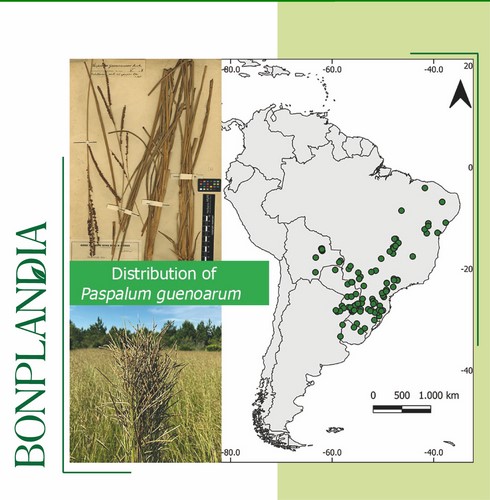
Predicción de la distribución de Paspalum guenoarum (Poaceae) utilizando variables ambientales y modelos de distribución ensamblados
DOI:
https://doi.org/10.30972/bon.3529466Palabras clave:
BIOMOD2, conservación de germoplasma, modelado de nicho ecológico, modelos ensamblados, Paspalum guenoarumResumen
Paspalum guenoarum Arechav. es una gramínea perenne nativa de América del Sur, altamente valorada por su producción continua de forraje durante todo el año y su notable tolerancia al frío. En este estudio, caracterizamos su distribución, identificamos las principales variables ambientales que la determinan y evaluamos el rendimiento predictivo de diferentes algoritmos utilizados para estimar su distribución potencial. A partir de registros de herbario y accesiones de germoplasma junto con variables ambientales, modelamos el nicho ecológico de la especie mediante un enfoque de modelado de consenso. Nuestros resultados indican que la especie se distribuye principalmente en el noreste de Argentina, el sur de Brasil, el norte de Uruguay y Paraguay, y se asocia a regiones subtropicales sin estación seca. Las variables bioclimáticas, particularmente la precipitación del mes más húmedo y el rango diurno de temperatura promedio, fueron los predictores más importantes, mientras que las variables edáficas y la elevación tuvieron una influencia secundaria. Los modelos de consenso produjeron predicciones más robustas que los algoritmos individuales; sin embargo, MaxEnt mostró un alto rendimiento predictivo y facilidad de implementación. En general, estos hallazgos proporcionan una base sólida para comprender la distribución y las preferencias ambientales de la especie, y ofrecen un marco de referencia para futuros estudios de modelado de distribución dentro del género Paspalum.
Descargas
Citas
Abrego, N. & Ovaskainen, O. (2023). Evaluating the predictive performance of presence–absence models: Why can the same model appear excellent or poor?. Ecology and Evolution 13: e10784. https://doi.org/10.1002/ece3.10784
Acuña, C. A., Martínez, E. J., Zilli, A. L., Brugnoli, E. A., Espinoza, F., Marcón, F., … et al. (2019). Reproductive systems in Paspalum: Relevance for germplasm collection and conservation, breeding techniques, and adoption of released cultivars. Frontiers in Plant Science 10: 1377. https://doi.org/10.3389/fpls.2019.01377
Adhikari, B., Subedi, S. C., Bhandari, S., Baral, K., Lamichhane, S. & Maraseni, T. (2023). Climate-driven decline in the habitat of the endemic spiny babbler (Turdoides nipalensis). Ecosphere 14: e4584. https://doi.org/10.1002/ecs2.4584
Aguilera, P. M., Sartor, M. E., Galdeano, F., Espinoza, F. & Quarin, C. L. (2011). Interspecific tetraploid hybrids between two forage grass species: sexual Paspalum plicatulum and apomictic P. guenoarum. Crop Science 51: 1544-1550. https://doi.org/10.2135/cropsci2010.10.0610
Allouche, O., Tsoar, A. & Kadmon, R. (2006). Assessing the accuracy of species distribution models: prevalence, kappa and the true skill statistic (TSS). Journal of Applied Ecology 43: 1223-1232. https://doi.org/10.1111/j.1365-2664.2006.01214.x
Anderson, R. P., Araújo, M. B., Guisan, A., Lobo, J. M., Martínez-Meyer, E., Peterson, A. T., … et al. (2020). Optimizing biodiversity informatics to improve information flow, data quality, and utility for science and society. Frontiers of Biogeography 12: e47815. https://doi.org/10.21425/F5FBG47839
Andrade, B. O., Bonilha, C. L., Overbeck, G. E., Vélez-Martin, E., Rolim, R. G., Bordignon, S. A. L., … et al. (2019). Classification of South Brazilian grasslands: Implications for conservation. Applied Vegetation Science 22: 168-184. https://doi.org/10.1111/avsc.12413
Arechavaleta, J. (1894). Las gramíneas uruguayas. Anales del Museo Nacional de Montevideo, 1: 56. Montevideo, Uruguay.
Beck, H. E., McVicar, T. R., Vergopolan, N., Berg, A., Lutsko, N. J., Dufour, A., … et al. (2023). High-resolution (1 km) Köppen-Geiger maps for 1901–2099 based on constrained CMIP6 projections. Scientific data 10: 724. https://doi.org/10.1038/s41597-023-02549-6
Burkart, A. (1975). Evolution of grasses and grasslands in South America. Taxon 24: 53-66. https://doi.org/10.2307/1219001
Changjun, G., Yanli, T., Linshan, L., Bo, W., Yili, Z., Haibin, Y., … et al. (2021). Predicting the potential global distribution of Ageratina adenophora under current and future climate change scenarios. Ecology and Evolution 11: 12092-12113. https://doi.org/10.1002/ece3.7974
Chen, Z., Zhang, Y. & Li, M. (2026). Evaluating the performance of species distribution models Biomod2 and MaxEnt in forest grassland fire prediction: an example from Sichuan Province, China. Geomatics, Natural Hazards and Risk 17: 2612203. https://doi.org/10.1080/19475705.2025.2612203
Dormann, C. F., Elith, J., Bacher, S., Buchmann, C., Carl, G., Carré, G., … et al. (2013). Collinearity: a review of methods to deal with it and a simulation study evaluating their performance. Ecography 36: 27-46. https://doi.org/10.1111/j.1600-0587.2012.07348.x
Elith, J. & Graham, C. H. (2009). Do they? How do they? Why do they differ? On finding reasons for differing performances of species distribution models. Ecography 32: 66-77. https://doi.org/10.1111/j.1600-0587.2008.05505.x
Elith, J., Graham, C. H., Anderson, R. P., Dudík, M., Ferrier, S., Guisan, A., … et al. (2006). Novel methods improve prediction of species’ distributions from occurrence data. Ecography 29: 129-151. https://doi.org/10.1111/j.2006.0906-7590.04596.x
Elith, J. & Leathwick, J. R. (2009). Species distribution models: ecological explanation and prediction across space and time. Annual review of ecology, evolution, and systematics 40: 677-697. https://doi.org/10.1146/annurev.ecolsys.110308.120159
Fick, S. E. & Hijmans, R. J. (2017). WorldClim 2: new 1-km spatial resolution climate surfaces for global land areas. International journal of climatology 37: 4302-4315. https://doi.org/10.1002/joc.5086
Giraldo, D. C. & Kucuker, D. M. (2025). Comparative analysis of Biomod2 statistical and machine learning methods for Lactarius deliciosus distribution in Refahiye, Turkiye. Fungal Biology 129: 101638. https://doi.org/10.1016/j.funbio.2025.101638
Glison, N., Romero, D., Rosso, V., Guerrero, J. C. & Speranza, P. R. (2023). Understanding the geographic patterns of closely-related species of Paspalum (Poaceae) using distribution modelling and seed germination traits. Plants 12: 1342. https://doi.org/10.3390/plants12061342
Guido, A., Varela, R. D., Baldassini, P. & Paruelo, J. (2014). Spatial and temporal variability in aboveground net primary production of Uruguayan grasslands. Rangeland Ecology & Management 67: 30-38. https://doi.org/10.2111/REM-D-12-00125.1
Hengl, T., Mendes de Jesus, J., Heuvelink, G. B., Ruiperez Gonzalez, M., Kilibarda, M., Blagotić, A., … et al. (2017). SoilGrids250m: Global gridded soil information based on machine learning. PLoS One 12: e0169748. https://doi.org/10.1371/journal.pone.0169748
Hijmans, R. J. (2025). raster: Geographic Data Analysis and Modeling. R package version 3.6-32. https://doi.org/10.32614/CRAN.package.raster
Hojsgaard, D., Honfi, A. I., Rua, G. & Daviña, J. (2009). Chromosome numbers and ploidy levels of Paspalum species from subtropical South America (Poaceae). Genetic Resources and Crop Evolution 56: 533-545. https://doi.org/10.1007/s10722-008-9384-0
Huang, Y., Li, T., Chen, W., Zhang, Y., Xu, Y., Guo, T., … et al. (2024). Analysis of the Distribution Pattern of Phenacoccus manihoti in China under Climate Change Based on the Biomod2 Model. Biology 13: 538. https://doi.org/10.3390/biology13070538
Jaurena, M., Durante, M., Devincenzi, T., Savian, J. V., Bendersky, D., Moojen, F. G., … et al. (2021). Native grasslands at the core: A new paradigm of intensification for the Campos of Southern South America to increase economic and environmental sustainability. Frontiers in Sustainable Food Systems 5: 547834. https://doi.org/10.3389/fsufs.2021.547834
Kang, Y., Lin, F., Yin, J., Han, Y., Zhu, M., Guo, Y., … et al. (2025). Projected distribution patterns of Alpinia officinarum in China under future climate scenarios: Insights from optimized Maxent and Biomod2 models. Frontiers in Plant Science 16: 1517060. https://doi.org/10.3389/fpls.2025.1517060
Karunarathne, P., Feduzka, C. & Hojsgaard, D. (2020). Ecological setup, ploidy diversity, and reproductive biology of Paspalum modestum, a promising wetland forage grass from South America. Genetics and Molecular Biology 43: e20190101. https://doi.org/10.1590/1678-4685-GMB-2019-0101
Kass, J. M., Vilela, B., Aiello-Lammens, M. E., Muscarella, R., Meroy, C. & Anderson, R. P. (2018). Wallace: A flexible platform for reproducible modeling of species niches and distributions built for community expansion. Methods in Ecology and Evolution 9: 1151-1156. https://doi.org/10.1111/2041-210X.12945
Knapp, A. K. & Smith, M. D. (2001). Variation among biomes in temporal dynamics of aboveground primary production. Science 291(5503): 481-484. https://doi.org/10.1126/science.291.5503.481
Konowalik, K. & Nosol, A. (2021). Evaluation metrics and validation of presence-only species distribution models based on distributional maps with varying coverage. Scientific Reports 11: 1482. https://doi.org/10.1038/s41598-020-80062-1
Lee, S., Cho, K. H. & Lee, W. (2016). Prediction of potential distributions of two invasive alien plants, Paspalum distichum and Ambrosia artemisiifolia, using species distribution model in Korean Peninsula. Ecology and Resilient Infrastructure 3: 189-200. https://doi.org/10.17820/eri.2016.3.3.189
Li, C. J., Xie, X. T. & Shi, T. (2025). Distribution Patterns of Platycodon grandiflorus From the Last Interglacial Period to the Future by Ecological Niche Modeling. Ecology and Evolution 15: e71198. https://doi.org/10.1002/ece3.71198
Li, J., Huang, Y., Pan, Y., Zhao, C., Yang, Y. & Yang, J. (2026). Prediction of potential suitable habitats of Cupressus duclouxiana under climate change based on Biomod2 Ensemble models. Biology 15: 165. https://doi.org/10.3390/biology15020165
Meyer, C., Kreft, H., Guralnick, R. & Jetz, W. (2015). Global priorities for an effective information basis of biodiversity distributions. Nature Communications 6: 1-8. https://doi.org/10.1038/ncomms9221
Mislevy, P. & Everett, P. H. (1981). Subtropical grass species response to different irrigation and harvest regimes 1. Agronomy Journal 73: 601-604.
Müller, S. C., Bergamin, R. S., Duarte, L. S., Peroni, N., Sühs, R. B. & Carlucci, M. B. (2023). In G. E. Overbeck, V. D. P. Pillar, S. C. Müller, & G. A. Bencke (Eds.), South Brazilian grasslands, pp. 417–443. Springer Nature, Switzerland. https://doi.org/10.1007/978-3-031-42580-6_16
Nabinger, C. & Dall’Agnol, M. (2019). Guia para reconhecimento de espécies dos Campos Sulinos. IBAMA, Brasília.
Olson, D. M., Dinerstein, E., Wikramanayake, E. D., Burgess, N. D., Powell, G. V., Underwood, E. C., … et al. (2001). Terrestrial Ecoregions of the World: A New Map of Life on Earth: A new global map of terrestrial ecoregions provides an innovative tool for conserving biodiversity. BioScience 51: 933-938. https://doi.org/10.1641/0006-3568(2001)051[0933:TEOTWA]2.0.CO;2
Overbeck, G. E., Müller, S. C., Fidelis, A., Pfadenhauer, J., Pillar, V. D., Blanco, C. C., … et al. (2007). Brazil’s neglected biome: the South Brazilian Campos. Perspectives in Plant Ecology, Evolution and Systematics 9: 101-116. https://doi.org/10.1016/j.ppees.2007.07.005
Paparamborda, I., Rossing, W. A., Soca, P. & Dogliotti, S. (2026). Archetypes of cow-calf systems on Campos grasslands from an ecological intensification perspective, their productivity and trophic performance. Agricultural Systems 231: 104533. https://doi.org/10.1016/j.agsy.2025.104533
Peterson, A. T., Soberón, J., Pearson, R. G., Anderson, R. P., Martínez-Meyer, E., Nakamura, M. & Araújo, M. B. (2011). Ecological niches and geographic distributions. Princeton University Press.
Quesenberry, K. H., Rios, E. F., Kenworthy, K. E., Blount, A. R. & Reith, P. E. (2022). Breeding forages with climate resiliency in temperate/tropical transition zones. Grass and Forage Science 77: 124-130. https://doi.org/10.1111/gfs.12566
Rota, F., Scherrer, D., Bergamini, A., Price, B., Walthert, L. & Baltensweiler, A. (2024). Unravelling the impact of soil data quality on species distribution models of temperate forest woody plants. Science of the Total Environment 944: 173719. https://doi.org/10.1016/j.scitotenv.2024.173719
Sari, İ., Ismael, B., Ullah, F., Agoundé, G. & Yildiz, F. (2026). Climatic variables as drivers of Pterocarpus erinaceus (Fabaceae): Distribution and the implications of climate change. Ecology and Evolution 16: e72820. https://doi.org/10.1002/ece3.72820
Sartor, M. E., Quarin, C. L. & Espinoza, F. (2009). Mode of reproduction of colchicine-induced Paspalum plicatulum tetraploids. Crop Science 49: 1270-1276. https://doi.org/10.2135/cropsci2008.05.0270
Scienza, C., Antoniolli, J., Longhi, J., Dias, L. W., Silveira, D. C., Sampaio, R., ... et al. (2024). Seed yield and quality of interspecific hybrids of Paspalum plicatulum x P. guenoarum at different harvest times. Crop Science 64: 697-709. https://doi.org/10.1002/csc2.21197
Silva, G. C., Solis Neffa, V. G., Zuquim, G. & Balslev, H. (2023). Biogeography and environmental preferences of Butia yatay (Mart.) Becc. Ecology and Evolution 13: e10749. https://doi.org/10.1002/ece3.10749
Steiner, M. G., Dall’Agnol, M., Nabinger, C., Scheffer-Basso, S. M., Weiler, R. L., Simioni, C., Schifino-Wittmann, M.T. & Motta, E. A. D. (2017). Forage potential of native ecotypes of Paspalum notatum and P. guenoarum. Anais da Academia Brasileira de Ciências 89: 1753-1760. https://doi.org/10.1590/0001-3765201720160662
Thuiller, W., Lafourcade, B., Engler, R. & Araújo, M. B. (2009). BIOMOD–a platform for ensemble forecasting of species distributions. Ecography 32: 369-373. https://doi.org/10.1111/j.1600-0587.2008.05742.x
Yang, L., Jia, H. & Hua, Q. (2025). Predicting suitable habitats of parasitic desert species based on Biomod2 ensemble model: Cynomorium songaricum Rupr and its host plants as an example. BMC Plant Biology 25: 351. https://doi.org/10.1186/s12870-025-06370-8
Zhang, L., Yang, C., Xie, G., Wang, P. & Wang, W. (2024). Assessment of the potential suitable habitat of Apriona rugicollis Chevrolat, 1852 (Coleoptera: Cerambycidae) under climate change and human activities based on the Biomod2 ensemble model. Insects 15: 930. https://doi.org/10.3390/insects15120930
Zhao, G., Cui, X., Sun, J., Li, T., Wang, Q. I., Ye, X. & Fan, B. (2021). Analysis of the distribution pattern of Chinese Ziziphus jujuba under climate change based on optimized biomod2 and MaxEnt models. Ecological Indicators 132: 108256. https://doi.org/10.1016/j.ecolind.2021.108256
Zuloaga, F. O., & Morrone, O. (2005). Revisión de las especies de Paspalum para América del Sur austral (Argentina, Bolivia, sur del Brasil, Chile, Paraguay y Uruguay). Monographs in Systematic Botany from the Missouri Botanical Garden 102: 1-297.
Descargas
Archivos adicionales
Publicado
Cómo citar
Número
Sección
Licencia
Derechos de autor 2026 Bonplandia

Esta obra está bajo una licencia internacional Creative Commons Atribución 4.0.
Declaration of Adhesion to Open Access
- All contents of Bonplandia journal are available online, open to all and for free, before they are printed.
Copyright Notice
- Bonplandia magazine allows authors to retain their copyright without restrictions.
- The journal is under a Creative Commons Attribution 4.0 International license.










.jpg)