Revista Veterinaria. 2026; 37(1)
https://doi.org/10.30972/vet.3719287
Comunicación breve


T.A. Vera1
E.R. Brizuela2
A. Avellaneda-Cáceres1
L.S. Aguirre3,4
V.G. Sandoval3,4,5
D.M. Medina3,4,5
N. Duport-Romanazzi5
Á. Ruiz5
J.F. Micheloud3,4,5,c1
Recibido: 21 diciembre 2025
Aceptado: 10 abril 2026
Abstract
This case report describes an outbreak of Nerium oleander poisoning in llamas in Jujuy, Argentina. The outbreak occurred after ingestion of pruned, dry plant material, resulting in a mortality rate of 27% (3/11 animals). Affected animals exhibited respiratory distress, tachycardia, mucus discharge from the anus, vulva, and nostrils, diarrhea, and acute nonspecific abdominal pain on palpation within 24 hours of ingestion. Deaths occurred within 48 hours of the onset of clinical signs. Necropsy findings included acute pulmonary congestion and edema, linear whitish streaks on the epicardial surface, and subendocardial hemorrhages. Plant fragments were identified in the first and second gastric compartments (C1 and C2). Histopathological examination revealed multifocal cardiomyocyte degeneration and necrosis. These findings are consistent with the well-documented cardiotoxic effects of N. oleander in various animal species. The rapid onset of clinical signs and fatal outcomes in affected animals underscores the high toxicity of this plant. This incident highlights the importance of raising awareness and implementing preventive measures among livestock producers, particularly regarding the presence of toxic ornamental plants in agricultural environments. Key words: toxic ornamental plants, cardiotoxicity, camelids.
Resumen. Se describe un caso de intoxicación por Nerium oleander en llamas en Jujuy-Argentina. El brote ocurrió luego de que los animales consumieran material vegetal podado y resultó en una tasa de mortalidad del 27% (3/11). Los animales afectados presentaron dificultad respiratoria, aumento de la frecuencia cardíaca, descarga mucosa por ano, vulva y narinas, diarrea y dolor agudo e inespecífico abdominal a la palpación dentro de las 24 horas. Las muertes ocurrieron dentro de las 48 horas del inicio de los signos clínicos. Los hallazgos de la necropsia incluyen congestión y edema pulmonar agudo, áreas lineales blanquecinas en la superficie del corazón y hemorragias subendocárdicas, además se identificaron fragmentos de la planta en el primer y segundo compartimento del estómago. El examen histopatológico reveló necrosis y degeneración multifocal de cardiomiocitos, además de hemorragias subendocárdicas. Estos hallazgos son consistentes con los efectos cardiotóxicos de N. oleander, ampliamente documentados en diversas especies animales. La rápida evolución del cuadro y el desenlace fatales en casi todos los animales afectados subrayan la elevada toxicidad de esta planta. Este incidente destaca la necesidad de una mayor concientización y de implementar medidas preventivas entre los productores, especialmente respecto de la presencia de plantas ornamentales tóxicas en entornos agropecuarios. Palabras clave: plantas ornamentales tóxicas, cardiotoxicidad, camélidos.
Nerium oleander L., a shrub belonging to the Apocynaceae family, is a widely distributed ornamental plant found in temperate and subtropical regions. Its resilience and tolerance make it common in urban green spaces (Galey et al. 1996). The plant's toxicity stems from the presence of cardiotoxic cardenolide glycosides, such as oleandrin and neriine. These compounds inhibit the Na+/K+ ATPase in cell membranes.
This disruption leads to intracellular calcium accumulation, which affects myocardial contractility and electrical conductivity (Galey et al. 1996, Langford and Boor 1996, Soto-Blanco et al. 2006). All parts of N. oleander, including the leaves, stems, and flowers, are toxic to humans, animals, and certain insects (Soto-Blanco et al. 2006). Reports indicate that ingesting just one leaf can be fatal, especially for children (Langford and Boor 1996).
This report presents an outbreak of N. oleander intoxication in a herd of llamas in Purmamarca, Jujuy Province, Argentina.
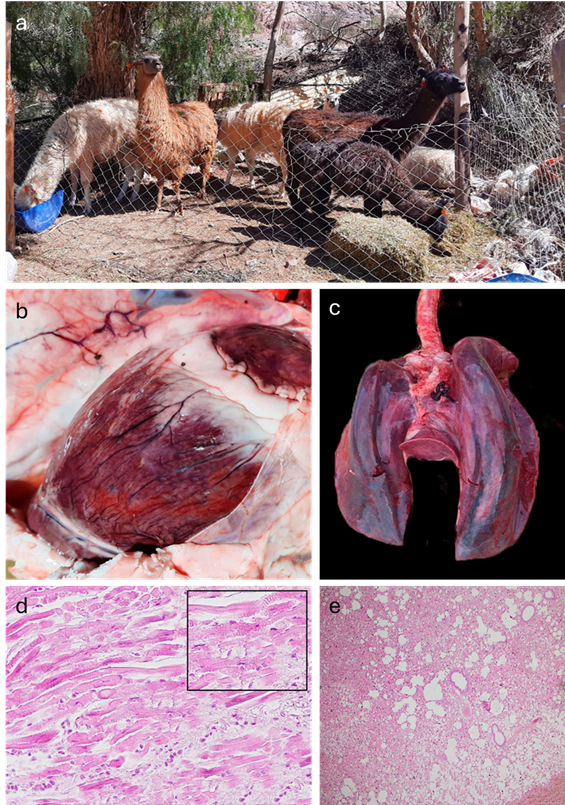
Case description. A small-scale farmer reported finding pruned plant remains scattered along the riverbed during a walk with tourists and llamas. He noted that the llamas (Figure 1a) were consuming the foliage. Because of the lack of food, he fed the animals the plant material on August 17, 2024.
The herd consisted of 11 llamas, including two males, two juveniles, and seven adult females. Three of the adult animals showed severe clinical signs and subsequently died, resulting in a mortality rate of 27% (3/11). The remaining animals in the herd did not exhibit any evident clinical signs during the observation period.
The affected llamas exhibited respiratory distress, tachycardia, mucous discharge from the nostrils and vulva, and diarrhea. Their diarrhea was semi-liquid and moderate in volume. The animals also showed signs of acute abdominal discomfort upon palpation. Clinical signs developed rapidly, with onset within 24 hours of ingestion. Two adult llamas died within the first 24 hours, and a third animal died 48 hours after exposure.
Two complete necropsies were performed on adult animals. During the procedure, samples were collected from the heart, lungs, liver, kidneys, spleen, and gastrointestinal tract. The samples were fixed in 10% buffered formalin for histopathological examination. The gastrointestinal contents were examined macroscopically for plant material.
The affected llamas exhibited respiratory distress, an increased heart rate, mucus discharge from their nostrils, vulvas, and anuses, diarrhea, and acute, nonspecific abdominal pain upon palpation. This clinical presentation is consistent with documented cases in the literature (Galey et al. 1996, Soto-Blanco et al. 2006). N. oleander poisoning is characterized by a variety of clinical signs, and the onset and severity depend on the amount of active principles ingested (Galey et al. 1996). In this case, the clinical signs appeared within 24 hours of ingestion, and the first death occurred within 48 hours (Riet-Correa et al. 2023).
Necropsy revealed no significant gross lesions except for acute pulmonary congestion with edema and linear whitish streaks on the cardiac surface. There were numerous endocardial and subendocardial ecchymoses and suffusions in both ventricles, accompanied by epicardial petechiae. Congestion of the mucosa in the first and second stomach compartments was also observed, along with identifiable plant fragments recovered from the contents (Figure b-c). While these findings are relatively nonspecific, they are consistent with those reported for Nerium spp. (Langford and Boor 1996, Riet-Correa et al. 2024) and other plants with acute cardiotoxic action (Riet-Correa et al. 2024).
Histological examination (Figure 1 d-e) revealed multifocal hyperemia in the myocardium, abundant subendocardial hemorrhages, and multifocal interstitial infiltration of lymphocytes and macrophages. Notable necrosis and degeneration of cardiomyocytes were observed, with shrunken, hypereosinophilic muscle fibers and contraction bands present in some areas. The kidneys exhibited diffuse passive hyperemia, mild multifocal hemorrhages, and mild multifocal lymphoplasmacytic interstitial nephritis. The liver exhibited mild non-suppurative periportal infiltration and moderate diffuse hyperemia, and the spleen showed moderate diffuse depletion of both the red and white pulp. The gastrointestinal tract displayed congestion and submucosal hemorrhage. These histopathological findings corroborate existing descriptions of N. oleander intoxication (Di Paolo et al. 2010, Streitenberger et al. 2022, Riet-Correa et al. 2024). Similar lesions have been described in animals poisoned by Persea americana leaves in South America, supporting its inclusion in the differential diagnosis (Freitas et al. 2022).
The diagnosis was confirmed by identifying N. oleander fragments in the first and second gastrointestinal compartments. Although microhistological evaluation is highly useful for confirming plant ingestion in cases of acute toxicosis (Cid et al. 2003, Giannitti et al. 2012, Aguirre et al. 2022), the presence of clearly identifiable fragments during necropsy was sufficient for a definitive diagnosis in this case. Consequently, the application of microhistological techniques would have been redundant. Although the amount of material consumed could not be quantified, it was likely abundant enough to be readily observed in the contents.
The literature extensively documents the toxicity of N. oleander in a wide range of animal species, including humans (Galey et al. 1996, Langford and Boor 1996). Camelids appear to be equally susceptible to intoxication, as detailed in this report and others (Di Paolo et al. 2010). However, higher mortality rates have been reported in cattle, goats and other domestic species (Streitenberger et al. 2022, Riet-Correa et al. 2023). The toxic dose of N. oleander has been estimated at around 0.005% of body weight on a dry matter basis for cattle and horses. Similar toxicity is exhibited by both fresh and dried leaves (Aslani et al. 2007). This high toxicity likely explains the severity and acute nature of this outbreak, which is similar to a previously reported incident in Argentina in which four out of 45 llamas died (Di Paolo et al. 2010).
This case underscores the importance of raising awareness about the risks associated with ornamental plants such as N. oleander in agricultural or urban-agricultural environments, particularly in regions where livestock may have access to toxic ornamental species. Despite the plant's low acceptability (Mack 1984) and camelids' feeding habits, accidental ingestion can occur in certain circumstances. This case demonstrates that it can result from consumption by animals unfamiliar with the plant or by their keepers who were unaware of its toxicity and assumed it was nontoxic when they saw the animals eating it. These cases emphasize the urgent need to educate farmers to prevent unintentional consumption and implement effective strategies to mitigate the risks posed by toxic plants.
Acknowledgements. We would like to express our gratitude to the institutions that enabled us to carry out this study and to the producers and veterinarians who trust in our diagnostic services.
CRediT authorship contribution statement. VTA: Data curation, Methodology (Necropsies), Revision and contributions to the original writing; BER: Data Curation, Methodology (Necropsies and plant identification), Revision and contributions to the original writing; ALS: Methodology (Histological techniques); AR: Methodology (Histological techniques); AA: Methodology (Histological techniques); SVG: Methodology (Histological techniques); MDM: Methodology (Histological techniques), Revision and contributions to the original writing; Duport-Romanazzi, N: Methodology (Histological techniques); MJF: Writing- Original - Reviewing and Editing, Methodology (Pathological analysis).
Declaration of interests. The authors declare that they have no known competing financial interests or personal relationships that could have appeared to influence the work reported in this paper.
