Revista Veterinaria. 2026; 37(1)
https://doi.org/10.30972/vet.3719289
Comunicación breve


J.F. Micheloud1,2,3,c1
M.R. Marini5
A.M. Canal5
1Instituto Nacional de Tecnología Agropecuaria (INTA), Instituto de Investigación Animal del Chaco Semiárido, Centro de Investigaciones Pecuarias, Área de Investigación en Salud Animal, Ruta Nacional 68 km 172 (4403) Cerrillos, Salta, Argentina.
2Consejo Nacional de Investigaciones Científicas y Técnicas (CONICET).
3Universidad Católica de Salta, Facultad de Ciencias Agrarias y Veterinarias, Campo Castañares (A4400EDD), Salta, Argentina.
4Actividad privada.
5Facultad de Ciencias Veterinarias, Universidad Nacional del Litoral.
Recibido: 28 enero 2026
Aceptado: 21 abril 2026
Abstract
Water buffalo production has expanded in South America as an alternative livestock system in marginal and flood-prone areas where environmental conditions limit cattle production. Solanum glaucophyllum, a calcinogenic plant widely distributed in these ecosystems, is a well-recognized cause of enzootic calcinosis in ruminants. This study describes a case of enzootic calcinosis in a buffalo herd from Formosa Province, Argentina, and summarizes the epidemiological, clinical, and pathological findings. Approximately 11,000 animals grazed year-round on natural pastures heavily infested with S. glaucophyllum, and the apparent clinical morbidity was estimated at 2%. Affected buffalo showed progressive weight loss, stiffness, locomotor impairment, prolonged recumbency, and anestrus. Necropsy and histopathology revealed extensive mineralization of soft tissues, particularly arteries, heart, lungs, and tendons, confirmed by von Kossa staining. These findings indicate that enzootic calcinosis should not be underestimated in buffalo production systems, where it may cause significant chronic and subclinical productive losses.
Key words:metastatic calcification, vitamin D, buffalo production, toxic plants.
Resumen. La producción bufalina se ha expandido en Sudamérica como una alternativa ganadera en regiones marginales e inundables donde las condiciones ambientales limitan la cría de bovinos. Solanum glaucophyllum, una planta calcinogénica ampliamente distribuida en estos ecosistemas, es una causa reconocida de calcinosis enzoótica en rumiantes. Este trabajo describe un caso de calcinosis enzoótica de calcinosis enzoótica en un rodeo de búfalos de la provincia de Formosa, Argentina, y resume los hallazgos epidemiológicos, clínicos y patológicos. Aproximadamente 11.000 animales pastoreaban durante todo el año en campos naturales fuertemente infestados por S. glaucophyllum, estimándose una morbilidad aparente clínica del 2%. Los animales afectados presentaron adelgazamiento progresivo, rigidez, alteraciones en la marcha, decúbito prolongado y anestro. La necropsia y el estudio histopatológico evidenciaron mineralización extensa de tejidos blandos, especialmente arterias, corazón, pulmones y tendones, confirmada mediante la tinción de von Kossa. Estos resultados indican que la calcinosis enzoótica no debe subestimarse en sistemas bufalinos, donde puede generar pérdidas productivas crónicas y subclínicas significativas.
Palabras clave:calcificación metastásica, vitamina D, producción bufalina, plantas tóxicas.
Solanum glaucophyllum, also known as S. malacoxylon, is a calcinogenic plant widely distributed in Argentina, Paraguay, Uruguay, and southern Brazil. It is recognized as one of the most important causes of enzootic calcinosis in grazing livestock (Gimeno 2000, Riet-Correa et al. 2023). It typically grows in low-lying, seasonally flooded, or marshy environments where extensive grazing systems may allow it to become abundant and pose a persistent toxicological risk (Gimeno 2000).
The toxic principle of S. glaucophyllum consists of glycosides that contain the biologically active compound 1,25-dihydroxyvitamin D3 (calcitriol). These glycosides disrupt calcium and phosphorus homeostasis, leading to hypercalcemia, hyperphosphatemia, and the widespread mineralization of soft tissues, particularly in the arteries, myocardium, lungs, and tendons (Machado et al. 2020). The disease is clinically chronic and progressive, associated with weight loss, stiffness, reduced productivity, and significant economic losses due to clinical and subclinical cases (Gimeno 2000, Mello 2003, Riet-Correa et al. 2023).
Cattle are most frequently affected by natural and experimental intoxication, but it has also been observed in sheep, goats, horses, pigs, and other domestic species (Machado et al. 2020). This demonstrates the broad susceptibility of these animals when exposed to sufficient levels of the toxin (Odriozola et al. 2018, Barale et al. 2024). Retrospective and outbreak-based studies confirm that enzootic calcinosis remains endemic in several regions of Argentina, causing sporadic or seasonal losses in grazing systems (Sosa et al. 2025).
Information regarding plant toxicoses and mineralization disorders in water buffalo (Bubalus bubalis) is comparatively scarce. Nevertheless, natural poisoning by S. glaucophyllum has been documented. Affected animals show progressive emaciation, locomotor impairment, and marked vascular and tendinous mineralization upon necropsy (Santos et al. 2011). Given the expansion of buffalo production in flood-prone areas overlapping with the ecological niche of S. glaucophyllum, it is important to better understand the toxicological risk associated with this plant in these production systems. Therefore, the aim of this study was to describe the clinical and pathological findings of enzootic calcinosis confirmed in two water buffalo, and to document the associated environmental conditions.
Study site and clinical evaluation. Epidemiological and clinicopathological data were collected during an on-site visit to a livestock farm in Pirané, Formosa Province, Argentina. A complete clinical examination was performed on the affected animals, paying special attention to their body condition, locomotor abnormalities, and general health. The herd was managed under an extensive production system in flood-prone areas, primarily oriented toward meat production. Animals grazed year-round on natural pastures without supplementation. Plant identification was performed based on morphological characteristics according to botanical descriptions (Gimeno 2000).
Necropsy and histopathology. Two severely affected animals were euthanized for diagnostic purposes and underwent complete necropsies. The euthanasia procedures and postmortem techniques were performed according to the standardized diagnostic and necropsy protocols typically used in our laboratory (Micheloud et al. 2025).
Representative tissue samples from multiple organs were collected, fixed in 10% neutral buffered formalin, processed routinely, embedded in paraffin, sectioned at 5 µm, and stained with hematoxylin and eosin (H&E) for histopathological evaluation. To confirm mineral deposition, selected lung, heart, and aorta sections were stained using the von Kossa method to detect calcium salts.
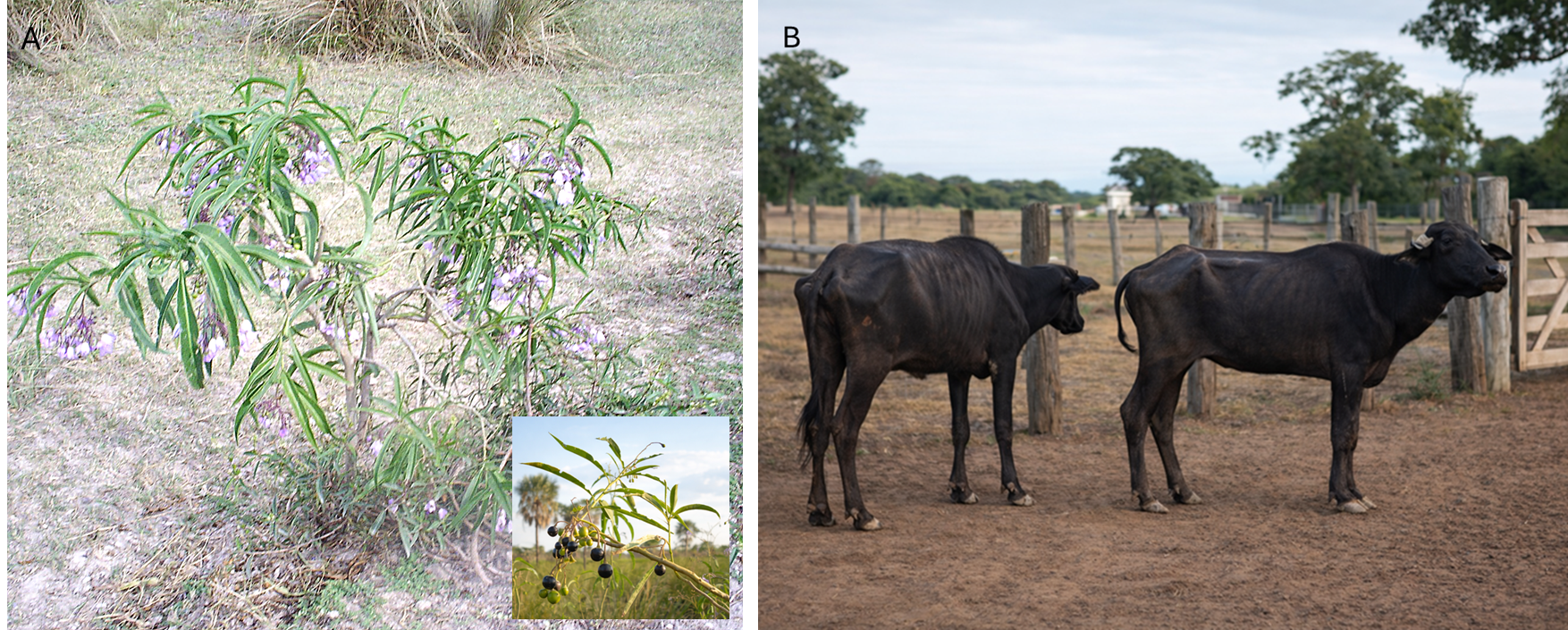
Environmental study. The cases were observed in a herd on a beef cattle farm located in Pirané, Formosa Province, Argentina, with a population of approximately 11,000 water buffalo (Bubalus bubalis). Animals were maintained year-round on natural pasture. The grazing area consisted of low-lying, flood-prone fields heavily infested with S. glaucophyllum (Figure 1. A).
The first clinically affected animals were observed in February 2009, and additional cases appeared progressively during the winter months. At the time of the farm visit (May 2009), the apparent proportion of animals showing compatible clinical signs was approximately 2% (220/11,000). No deaths were recorded; however, affected animals were reportedly culled or sold before death due to progressive deterioration in body condition and productivity.
Clinical findings. Affected animals (Figure 1. B) showed progressive weight loss and locomotor impairment. Gait was stiff and characterized by arching of the back and reluctance to move. Prolonged recumbency was frequently observed. In females, anestrus was a consistent and prominent finding.
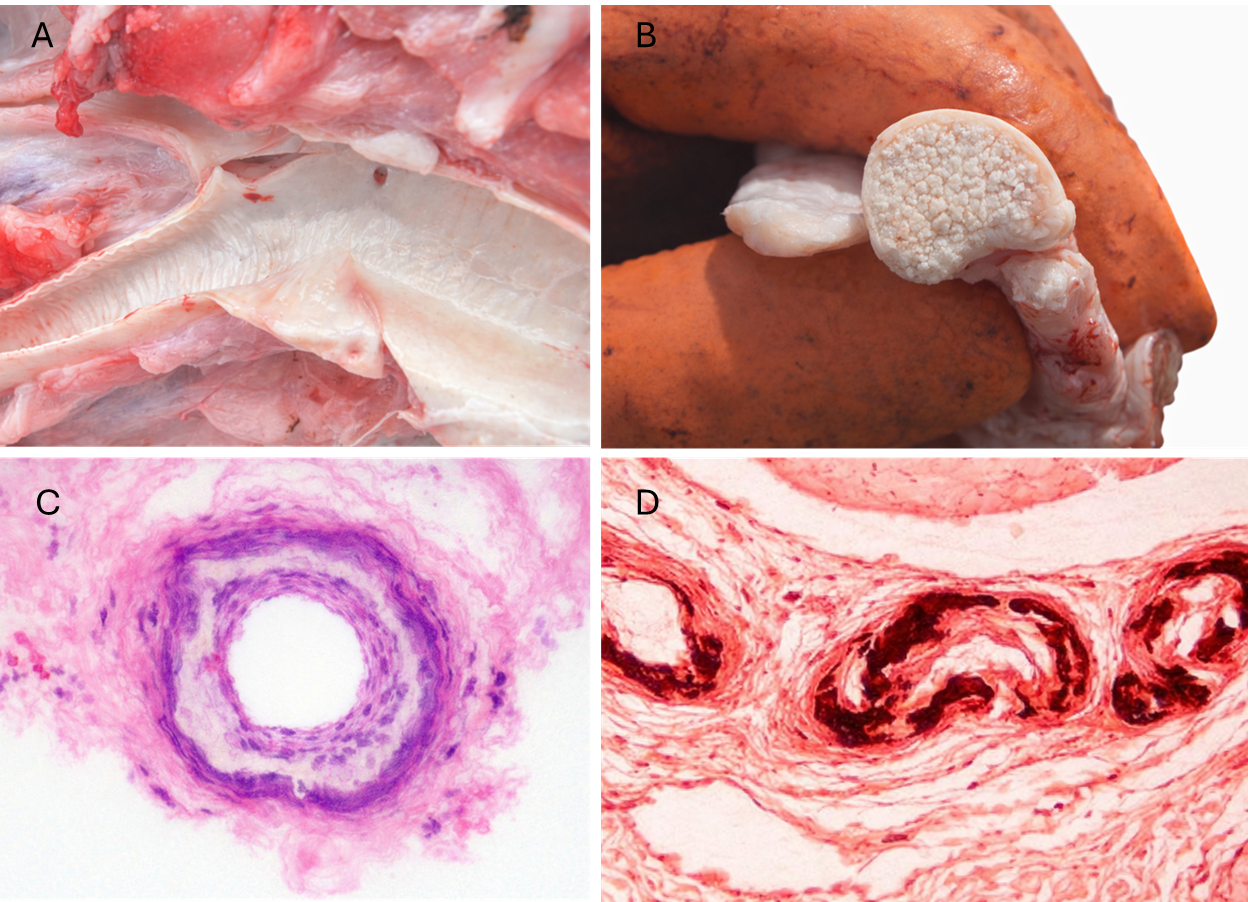
Gross pathology. Both necropsied animals were in poor body condition and showed marked pallor of the mucous membranes. Ovarian atrophy was evident. Postmortem examination revealed thickening and loss of elasticity of the cardiac valves (mitral and aortic) and of the walls of the aorta and carotid arteries (Figure 2. A). These areas were firm, opaque, rough, and pearly-white, and produced a gritty or crepitant sensation on cut section. Similar opaque, firm, and crepitant areas were observed in tendons (Figure 2. B). No significant gross lesions were detected in the lungs.
Histopathology. Histologically, affected vessels and soft tissues showed multifocal to coalescing areas of mineralization characterized by swollen and fragmented elastic fibers with granular basophilic deposits between them (Figure 2. C, D). In severely affected areas, proliferation of fibroblast-like cells resembling embryonic mesenchymal tissue was observed, and foci of osseous metaplasia were occasionally present. Von Kossa staining confirmed calcium salt deposition within arteries, lungs, heart, and tendons.
The diagnosis of enzootic calcinosis in the present cases was supported by the epidemiological context, the abundant presence of S. glaucophyllum in grazing areas, the clinical presentation, and the characteristic gross and histopathological findings. Soft tissue mineralization was confirmed using the von Kossa stain, which demonstrated calcium salt deposition in the arteries, myocardium, lungs, and tendons. The diagnosis of enzootic calcinosis was confirmed in two necropsied animals. The remaining animals were classified as clinically suspected cases based on similar clinical signs, without confirmatory diagnostic testing.
During active consumption of calcinogenic plants such as S. glaucophyllum, affected animals may exhibit increased serum calcium and phosphorus concentrations (Machado et al. 2020). However, clinically affected animals are not necessarily consuming the plant at the time of clinical evaluation, particularly in chronic cases. In the present study, these determinations were not performed due to the lack of adequate conditions for proper sample collection and preservation during field intervention.
The clinical and pathological findings observed in the buffalo were consistent with those previously reported in other species with enzootic calcinosis (Machado et al. 2020). These findings included progressive weight loss, stiffness, prolonged recumbency, and widespread mineralization of the vascular and connective tissues (Gimeno 2000). These similarities are expected given that the pathogenesis of the disease is mediated by ingesting calcinogenic glycosides containing biologically active 1,25-dihydroxyvitamin D, which disrupts mineral metabolism and promotes metastatic calcification (Machado et al. 2020).
Though reports on buffalo are scarce, natural intoxication by S. glaucophyllum has been documented in this species in Brazil, exhibiting comparable clinical signs and lesions (Santos et al. 2011). This study confirms the natural occurrence of enzootic calcinosis in a meat-producing buffalo herd in Formosa Province, Argentina, thereby expanding the geographical and species distribution of the disease. Other toxic plants may produce similar clinical and pathological conditions in livestock, including Nierembergia veitchii, N. rivularis, and S. stukerty (Machado et al. 2020). However, the presence of these species was ruled out in the grazing areas evaluated. A limitation of this study is that only two animals were necropsied, and no confirmatory diagnostic tests were performed in the remaining clinically affected animals.
From a production standpoint, buffalo are often raised in marginal, low-lying, or flood-prone areas, which are ideal environments for S. glaucophyllum. This ecological overlap increases the risk of exposure and favors the occurrence of cases. Importantly, enzootic calcinosis is usually chronic and is often associated with subclinical losses that may go unnoticed. Reported consequences include reduced weight gain, poor feed conversion, reproductive failure, and increased susceptibility to other diseases (Gimeno 2000). Consequently, economic losses may occur even in the absence of overt mortality, and affected animals are often culled or sold prematurely, as observed in the present case.
Recent reviews emphasize that calcinogenic plant intoxications are an underdiagnosed problem in extensive grazing systems in South America, particularly where surveillance and diagnostic confirmation are limited (Machado et al. 2020, Riet-Correa et al. 2023). Consequently, the disease may be substantially underestimated in buffalo production systems where specific health data are scarce.
This study documents a case of S. glaucophyllum poisoning in water buffalo and demonstrates that its epidemiological, clinical, and pathological features closely resemble those in cattle. Increased awareness, improved pasture management, and further research are necessary to determine the susceptibility of buffalo and quantify the economic impact of enzootic calcinosis in bubaline production systems.
Acknowledgments. The authors gratefully acknowledge INTA and CONICET, the current institutional affiliations of J. F. Micheloud, for their support of this work. We also thank the Universidad Nacional del Litoral, where all authors received their undergraduate training and have served or continue to serve as faculty members.
CRediT authorship contribution statement. MJF: Conceptualization, funding acquisition, project administration, methodology, investigation, data analysis, supervision, writing – original draft, writing – review and editing. PBR: Investigation, sample collection, field necropsies, data curation. SA: Investigation, laboratory procedures, data curation. MMR: Investigation, laboratory procedures, histopathology processing. BEE: Data curation, records management, formal analysis support. CAM: Investigation, histopathological evaluation, validation, writing – review and editing.
Declaration of competing interest. The authors declare that they have no known competing financial interests or personal relationships that could have appeared to influence the work reported in this paper.
Data availability. Data will be made available on request.
