Revista Veterinaria. 2026; 37
https://doi.org/10.30972/vet.3719685
Artículo Original


Rodríguez-Sivira, E. 1

Inostroza-Briones, D. 2,3
Escobar-Chihuaillán, K. 4,c1
Moraga-Alarcón, D. 5
Maluenda-Carilao, V. 5
1 Facultad de Medicina Veterinaria y Agronomía, Universidad de Las Américas, Los Castaños 7 Norte 1348 Campus Viña del Mar, Chile.
2 Facultad de Recursos Naturales y Medicina Veterinaria, Universidad Santo Tomás. Avenida Carlos Schorr, Talca, Chile.
3 Facultad de Ciencias, Doctorado en Conservación y Gestión de la Biodiversidad, Universidad Santo Tomás, Avenida Ejército 146, Santiago, Chile.
4 Facultad de Recursos Naturales, Universidad Católica de Temuco. Avenida Rudecindo Ortega 02950, Temuco, Chile.
5 Facultad de Recursos Naturales y Medicina Veterinaria, Universidad Santo Tomás. Avenida Limonares, Viña del Mar, Chile.
Recibido: 19 febrero 2026
Aceptado: 19 agosto 2026
Abstract
Reproductive efficiency is key to the equine industry and is supported by various tools to ensure its success, with transrectal ultrasound monitoring being essential to optimize reproductive programs. The mare is a long-day seasonal polyestrous species whose reproductive activity depends on the hypothalamic-pituitary-ovarian axis, regulated by the hormones GnRH, FSH, and LH, which control follicular growth, ovulation, and corpus luteum formation. During the estrous cycle, follicular waves and hormonal changes occur that allow the identification of the transition, estrus, and diestrus phases. An observational, descriptive, longitudinal study was conducted using 223 ultrasound records of mares that were admitted to a reproductive center during September from 2015 to 2024 in Chile. The spring transition phase predominated (48.4%), followed by diestrus (38.1%) and estrus (13%). Additionally, the average diameter of the dominant follicle was 33.5 ± 7.7 mm, close to the preovulatory size. A functional corpus luteum was observed in 38.1% of the mares. Significant intramonthly variations were observed, with the proportion of mares in transition decreasing toward the end of September, while estrus and diestrus increased, reflecting ovarian reactivation associated with the increase in photoperiod. The findings confirm the physiological progression of spring reproductive activity and highlight the importance of individualized ultrasound monitoring to optimize reproductive management.
Key words: Ovarian dynamics, Estrous cycle, Photoperiod, Mare, Reproductive physiology.
Resumen
La eficiencia reproductiva es clave en la industria equina y esta se apoya en distintas herramientas que garanticen su éxito, siendo fundamental el monitoreo ecográfico transrectal que resulta esencial para optimizar los programas reproductivos. La yegua es poliéstrica estacional de días largos dependiente de la actividad del eje hipotálamo-hipófisis-ovario, regulado por las hormonas GnRH, FSH y LH, las que controlan el crecimiento folicular, la ovulación y formación del cuerpo lúteo. Durante el ciclo estral ocurren ondas foliculares y cambios hormonales que permiten identificar las fases de transición, estro y diestro. Se realizó un estudio observacional descriptivo longitudinal de 223 registros ecográficos de yeguas que ingresaron a un centro de reproducción durante septiembre del 2015-2024 en Chile. Se observó la predominancia de la fase de transición de primavera (48,4%), seguida de diestro (38,1%) y estro (13%), además el diámetro promedio de folículo dominante fue de 33,5 ± 7,7 mm, cercano al tamaño preovulatorio. El 38,1% presentó cuerpo lúteo funcional. Se observaron variaciones intramensuales significativas, donde la transición disminuyó hacia fines de septiembre, aumentaron el estro y diestro, reflejando la reactivación ovárica asociada al incremento del fotoperíodo. Los hallazgos confirman la progresión fisiológica primaveral y resaltan la importancia del monitoreo ecográfico individualizado para optimizar el manejo reproductivo.
Palabras clave: Dinámica Ovárica, Ciclo estral, Fotoperíodo, Yegua, Fisiología reproductiva.
Reproductive efficiency constitutes a strategic pillar in the equine industry, where the optimization of breeding programs impacts the productivity and genetic value of the animals. To guarantee this stage, various reproductive biotechnologies are employed, such as artificial insemination (AI), intracytoplasmic sperm injection (ICSI), gamete collection and cryopreservation, and in vitro fertilization (IVF) (Gibber 2023). Regardless of the technique used, transrectal ultrasound monitoring has consolidated as an essential tool, as it allows real-time evaluation of the ovarian and uterine dynamics of the mare, optimizing clinical decision-making and improving reproductive success rates (Ortega-Ferrusola et al 2022).
The mare presents a photoperiodic reproductive physiology that is seasonal polyestrous of long days (Trundell 2020), which implies ovarian activity when the duration of daylight increases. In the southern hemisphere, particularly in the central zone of Chile (33.8°S), this phenomenon occurs during the spring equinox, close to the third week of September, this period corresponding to the transition from the winter anestrus to the spring reproductive activity.
The reproductive activity depends on the hypothalamic-pituitary-ovarian (HPO) axis. The hypothalamus secretes gonadotropin-releasing hormone (GnRH) in a pulsatile manner; the frequency and amplitude of these pulses determine the pituitary response and are modulated by the feedback of ovarian steroids and by the influence of melatonin associated with the photoperiod. The GnRH reaches the adenohypophysis through the hypophyseal portal system, stimulating the synthesis and release of follicle-stimulating hormone (FSH) and luteinizing hormone (LH) (Trundell 2020). The FSH promotes the recruitment and initial growth of ovarian follicles, while the LH participates in the final maturation of the dominant follicle, triggering ovulation and subsequent formation of the corpus luteum (CL) (Akhtar et al. 2025). These gonadotropins act on the ovary stimulating the production of estradiol (E2) by the growing follicles and progesterone (P4) by the CL.
During the estrous cycle, a follicular dynamic characterized by waves of recruitment, selection, and dominance develops. Usually, two main waves are described. The first, called the minor follicular wave, occurs during early diestrus; in this phase, although a larger follicle emerges, ovulation does not occur due to the high concentrations of P4 secreted by the CL, which inhibit the preovulatory peak of LH. The CL, a remnant structure of the previous ovulation, is the main source of P4 and maintains the luteal phase. Around days 14 to 16 post-ovulation, the endometrium secretes prostaglandin F2α (PGF2α), responsible for luteolysis. The regression of the CL causes a sharp drop in P4, which eliminates the negative feedback on the HPO axis and allows the increase of FSH and LH during late diestrus and proestrus, allowing the progression of the major follicular wave where the dominant follicle (DF) acquires ovulatory capacity (Suqui-Mocha et al. 2024). Initially, low concentrations of E2 exert negative feedback; however, as the DF matures, it produces larger amounts of E2 and inhibin, which reduces the secretion of FSH, generating atresia of the subordinate follicles (Álvarez Gallardo et al. 2023). The sustained increase of E2 induces the behavioral and uterine changes characteristic of estrus and generates positive feedback that culminates with the peak of LH and ovulation (Trundell 2020).
The precise characterization of the spring transition period is fundamental to maximize reproductive efficiency. Ultrasonographically, this phase is associated with the presence of multiple small and medium-sized follicles (6 to 21 mm), resembling a bunch of grapes. The DF is identified when it exceeds approximately 35 mm in diameter; when it reaches between 35 to 60 mm, it is called a preovulatory follicle. In the 24 hours prior to ovulation, a morphological change can be observed from a spherical or oval shape to a pear or oblong shape (Simon et al. 2020).
The timely identification of these findings through ultrasound allows for a more precise determination of the stage of the estrous cycle and adjustment of therapeutic interventions in assisted reproduction programs. In this context, the ultrasound evidence in mares entering reproductive programs during the month of September between 2015 and 2024 in Chile is analyzed with the purpose of identifying temporal variations.
Study setting and population. The study was conducted at the Bioteq Chile Equine Reproduction and Fertility Center in Paine, Chile. The study population comprised donor and recipient mares with clinical records containing transrectal ultrasonographic examinations performed during September between 2015 and 2024.
Study design. A retrospective observational study was conducted over 10 consecutive breeding seasons (2015-2016 to 2024-2025). The unit of analysis was the mare, and only the first eligible ultrasonographic examination performed between September 1 and 30 of each season was included. A total of 223 records met the eligible criteria, with a mean of 22.3 mares per season (range, 8-43).
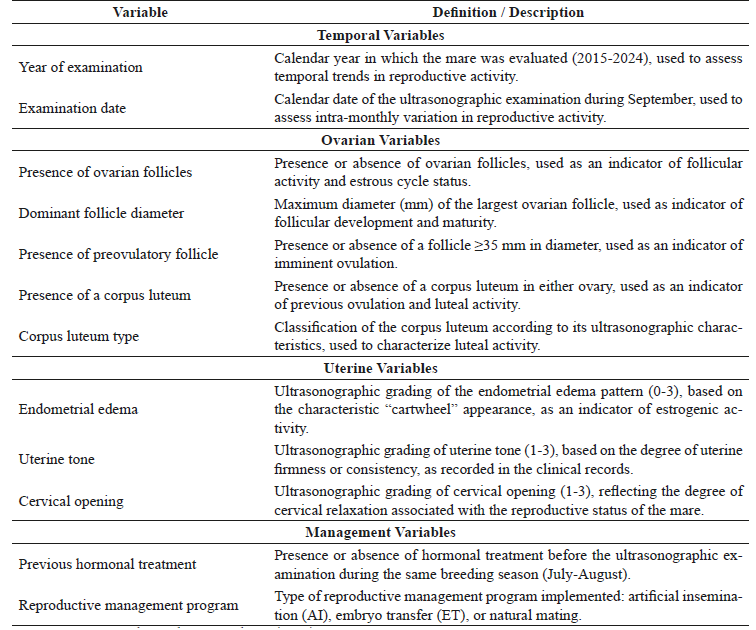
Data collection. Data were collected during a visit to the Bioteq Center in October 2025. Eligible clinical records were identified and screened according to the predefined inclusion and exclusion criteria. Relevant information was photographically documented and subsequently transcribed into a standardized Microsoft Excel data containing all variables listed in Table 1. For each mare, the first eligible September examination was recorded, regardless of whether it represented the initial examination of the season or a follow-up examination, provided that no hormonal treatment had been administered previously during the same breeding season.
Inclusion and exclusion criteria. Non-pregnant mares were included, without a history of hormonal treatments during July and August of the same breeding season. Mares presenting ultrasonographic findings compatible with uterine abnormalities, including endometritis, endometrial cysts, or uterine fibrosis, were excluded. Records with incomplete or illegible information or inconsistencies in the evaluated parameters were also excluded.
Limitations of the study. The absence of data such as age and breed limit the analysis by subgroups, considering the variability between young and geriatric mares, as well as by breed and/or by type of sport or productive function of the mare. The study was conducted in a single equine reproduction center, located in Paine, Metropolitan Region, which restricts the extrapolation of the results to other areas of Chile with different climatic conditions. Finally, the design did not allow for controlling possible confounding variables, such as individual reproductive history, previous nutritional management, stress factors, or modifications in the internal protocols of the center.
Procedure and variables. Transrectal ultrasonographic examinations were performed in B-mode using 5.0 and 7.5-MHz linear transducers. Reproductive status was determined using an integrated criterion based on Icatt-Garandán and Jorge-Colmán (2022), considering the presence of a corpus luteum (CL) in the left (LO) or right ovary (RO), presence of dominant follicles (DF) in either ovary, total follicle count when applicable, presence of a preovulatory follicle, degree of endometrial edema (0-3), uterine tone (1-3), and degree of cervical opening (1-3). Uterine tone was recorded from the ultrasonographic evaluation documented in the clinical records and graded on a three-point scale (1-3), according to the criteria used at the study center. These parameters were used to classify mares according to reproductive status as diestrus, estrus, transition, or anestrus.
The variables were categorized by reproductive season (year) and by date of entry, subdivided into thirds of the month (beginning, middle, and end). Likewise, ovarian characteristics such as presence and diameter of the DF (mm), and type of CL were recorded.
Statistical analysis. Descriptive statistics were used to summarize the data, including absolute and relative frequencies, measures of central tendency (mean, median, and mode), and measures of dispersion (standard deviation and range). Reproductive cycle phases were classified based on an integrated assessment of ovarian and uterine ultrasonographic findings, including the presence and type of corpus luteum, follicular activity and diameter, presence of a preovulatory follicle (≥ 35 mm), endometrial edema, uterine tone, and cervical opening. Mares with a corpus luteum were classified as being in diestrus, whereas mares without a corpus luteum and with a preovulatory follicle (≥ 35 mm) accompanied by uterine and cervical signs compatible with estrogenic activity were classified as being in estrus. The transition phase was defined by the absence of corpus luteum and the presence of multiple small- to medium- sized follicles without clear follicular dominance or sufficient uterine and cervical signs to classify the mare as being in estrus. Mares without a corpus luteum and with absent or minimal follicular activity were classified as being in anestrus. To evaluate interannual and intramonthly temporal trends in the distribution of reproductive cycle phases, the Chi-square test (χ²) was applied. Statistical significance was set at p <0.05.
Ethical implications. Due to the retrospective and observational design of the study and the use of anonymous records, approval from an animal bioethics committee was not required.
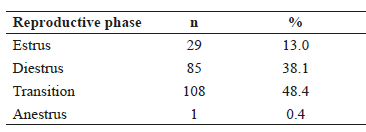
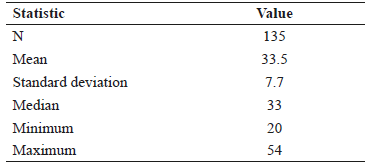
Characterization of the reproductive state: follicular and luteal dynamics. Of the 223 mares evaluated, the predominant reproductive phase in September was the spring transition (48.4%; n = 108) (Table 2), followed by diestrus and estrus. In 135 mares (60.5%), the measurement of the DF was recorded, which allowed for determining an average diameter of 33.5 mm, with a standard deviation of 7.7 mm (Table 3).
Presence and distribution of the corpus luteum. Regarding luteal activity, 38.1% (n = 85) of the mares presented at least one CL, predominantly functional. CL activity was observed in the right ovary in 19.3% (n = 43) of mares, in the left ovary in 17.0% (n = 38), and bilaterally in 1.8% (n = 4), confirming a slight predominance of activity in the right ovary compared to the left; the remaining 61.9% (n = 138) of mares showed no evidence of CL in either ovary.
Uterine and cervical characteristics. The evaluation of the reproductive tract showed a predominance of intermediate degrees. The endometrial edema presented a mode and median of grade 1 (n = 59), while the uterine tone and cervical opening recorded a mode and median of grade 2.
Temporal variations. The intramonthly analysis showed statistically significant variations in the distribution of reproductive phases as September progressed, with a clear decline in the proportion of mares in transition and a parallel increase in estrus and diestrus toward the end of the month (Table 4).

The results of the Chi-square analysis revealed a statistically significant intramonthly variation (χ² = 21.43, df = 4, p <0.001), whereas interannual variation was not significant (χ² = 24.65, df = 18, p = 0.135).
During the ten reproductive seasons, 223 mares were evaluated, of which 48.4% were in the spring transition phase. Despite the increase in photoperiod, these females had not yet reached ovarian competence at the time of entering the breeding program. In this phase, FSH concentrations are sufficient for follicular recruitment, but LH levels remain low, insufficient to trigger ovulation (Robledo-Reyes et al. 2024). The ultrasound findings showed great heterogeneity, with multiple small to medium-sized follicles without clear dominance, generating a pattern known as "bunch of grapes" (Simon et al. 2020), characteristic of this temporal window. Some mares presented dominant follicles, but in the absence of signs of estrogenic activity, which prevented their classification as estrus. This variability is physiologically normal, reflecting the gradual reactivation post-anestrus, where mares progress from disorganized follicular recruitment to follicular dominance and ovarian competence (Ortega-Ferrusola et al. 2022).
The 38.1% of the mares were in diestrus, indicating that more than a third of the population had already completed the transition and experienced at least one ovulation before entering the center. This finding reflects individual variability in the onset of reproductive activity, influenced by extrinsic factors such as nutritional management and previous conditions, which determine the timing of ovarian reactivation (Akhtar et al. 2025).
The 13% of mares were in estrus at the time of evaluation, which is physiologically expected, as this phase lasts only 5 to 7 days within an estrous cycle of approximately 21 days (Robledo-Reyes et al 2024). Likewise, the finding of 0.4% of mares in deep anestrus aligns with previous reports, as in the southern hemisphere and at similar latitudes, this phase typically resolves during August, leading to the progressive reactivation of the reproductive cycle (Simon et al. 2020).
An average diameter of the DF of 33.5 ± 7.7 mm was recorded, slightly below the threshold of 35 mm used to classify preovulatory follicles (Simon et al. 2020), which is relevant given that 48.4% of the mares were in the transition phase upon entry. During the follicular phase, the DFs grow approximately 2.7 mm/day, reaching an average of 45.3 mm the day before ovulation (Azevedo et al. 2021), suggesting that the evaluated mares were between 4 to 5 days from a potential ovulation, consistent with late transition or early estrus. The wide standard deviation (7.7 mm) reflects the heterogeneity of the population, highlighting the importance of individualized and planned ultrasound monitoring in assisted reproduction programs, especially during the month of September.
The presence of CL in 38.1% of the mares indicates that a third of the population had ovulated at least once before the ultrasound examination. Of the total CL observed, 64.8% were functional, suggesting that these females were in medium diestrus (5 to 14 days post-ovulation), characterized by high P4 production and optimal luteal function (Témaj de la Cruz and Sandoval Menémdez 2024). The distribution of the different types of CL (recent, hemorrhagic, functional, in lysis, small, and residual) provides precise information about the moment of the mare at the time of evaluation, essential for planning reproductive interventions (Suqui-Mocha et al. 2024). Furthermore, greater luteal activity was observed in the right ovary compared to the left.
The evaluation of uterine and cervical variables showed predominance of intermediate degrees. The endometrial edema, assessed by the "wheel of cart" sign, as an indicator of estrogenic influence by follicular activity (Trundell 2020), predominated at grade 1, consistent with the transition phase. This edema reaches its peak (grade 2-3) between 36-48 hours before ovulation, coinciding with the expression of estrus due to increased E2, and decreases progressively until ovulation. For its part, the uterine tone and cervical opening, predominant at grade 2, reflect the balance between E2 and P4 (Balcázar et al. 2024), representing an intermediate pattern in a population with different phases of the reproductive cycle.
The analysis of the distribution of reproductive phases during September revealed statistically significant differences (χ² = 21.43, df = 4, p <0.05), evidencing a clear progression in ovarian activity throughout the month. The transition phase decreased significantly, from 67.6% at the beginning of the month to 37.5% at the end, while the proportion of mares in estrus increased from 5.4% to 20.2%. These trends reflect the physiological response to the progressive increase in photoperiod in the southern hemisphere, which reduces melatonin secretion and gradually releases the HPO axis from its inhibitory effect (Newcombe and Tortonese 2025). This allows for the recovery of pulsatile GnRH secretion, increased LH, and the acquisition of ovulatory competence. This monthly variability has practical implications for reproductive management: mares evaluated at the beginning of September present a higher probability of requiring induction of cyclicity or prolonged waiting periods before reaching optimal conditions for insemination. In contrast, mares evaluated at the end of September have a higher probability of being reproductively active, allowing for a more immediate start of assisted reproduction protocols.
Between 2015 and 2024, the Chi-square analysis did not reveal significant differences (χ² = 24.65, df = 18, p = 0.135), indicating that the annual variations observed in the distribution of records do not reflect systematic temporal changes.
Acknowledgment. The authors thank the Bioteq Chile Equine Reproduction and Fertility Center, located in Paine Metropolitan Region of Chile.
CRediT authorship contribution statement. Conceptualization: RSE, IBD, Methodology: RSE, IBD, Investigation: RSE, Data Curation: RSE, Formal Analysis: IBD, ECK, MAD, MCV, Supervision: IBD, Writing-Original Draft: RSE, IBD, Writing-Review and Editing: All authors.↩︎
 st.escovar@gmail.com