
Macrohongos de la Reserva Natural Paraje Tres Cerros (Corrientes, Argentina)
DOI:
https://doi.org/10.30972/bon.3428442Palabras clave:
Ascomycota, Basidiomycota, biodiversidadResumen
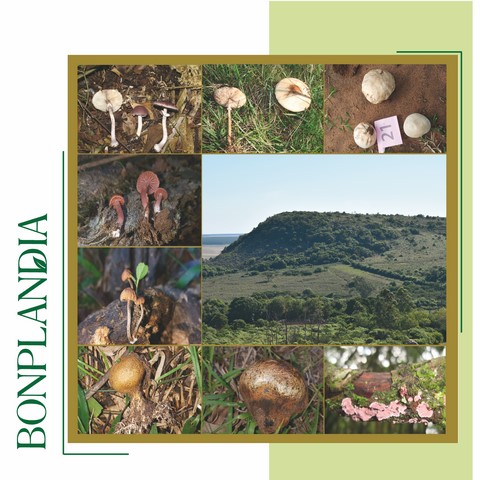
La Reserva Natural Privada Paraje Tres Cerros es un lugar atípico del litoral argentino, caracterizado por su relieve con lomas y cerrillos. En la región del Nordeste Argentino (NEA), la mayoría de los estudios sobre la diversidad de hongos se han centrado en las Selvas Mixtas de Misiones, pero la provincia de Corrientes está escasamente estudiada. Por lo tanto, el objetivo de este trabajo fue documentar la funga de la Reserva Natural Paraje Tres Cerros, en la provincia de Corrientes. Se proporciona un listado de 34 especies de macrohongos: dos del Phylum Ascomycota, distribuidas en dos familias y 32 pertenecientes al Phylum Basidiomycota,
distribuidas en 17 familias. Se incluyen descripciones taxonómicas de las especies que representan nuevos registros para la región del NEA: Leucoagaricus lilaceus, Macrolepiota kerandi, Laccaria fraterna, Ceriporia spissa, Bovista delicata, Pisolithus tinctorius, Scleroderma areolatum y Psilocybe coprophila.
Descargas
Citas
Agüero, A. N., Hladki, A. I. & Dios, M. M. (2011). El género Poronia (Xylariaceae) en la provincia de Catamarca, Argentina. Lilloa 48: 60-64.
Alberti, M., Niveiro, N., Zied, D. C. & Albertó, E. O. (2020). Identification of Oudemansiella canarii and O. cubensis (Basidiomycota, Physalacriaceae) in Argentina using morphological, culture and molecular analysis. Harvard Papers in Botany 25: 131-143. https://doi.org/10.3100/hpib.v25iss2.2020.n1
Barroetaveña, C., Rajchenberg, M. & Cázares, E. (2005). Mycorrhizal fungi in Pinus ponderosa introduced in Central Patagonia (Argentina). Nova Hedwigia 80: 453-464. http://dx.doi. org/10.1127/0029-5035/2005/0080-0453
Battaglia, A. A. C. (1949). Estudio preliminar sobre la geología del margen del río Uruguay, en la provincia de Corrientes. Instituto Nacional de Geología y Minería. Inéditos SEGEMAR.
Cajade, R., Medina, W., Salas, R., Fandiño, B., Paracampo, A., García, I., Pautasso, A., Piñeiro, J. M., Acosta, J. L., Zaracho, V. H., Avalos, A., Gomez, F., Odriozola, M. P., Ingaramo, M. R., Contreras, F. I., Rivolta, M. D., Hernando, A. B. & Álvarez, B. B. (2013a). Las islas rocosas del Paraje Tres Cerros: un refugio de biodiversidad en el litoral mesopotámico argentino. Biológica 16: 147-159.
Cajade, R., Etchepare, E. G., Falcione, C., Barrasso, D. A. & Álvarez, B. B. (2013b). A new species of Homonota (Reptilia: Squamata: Gekkota: Phyllodactylidae) endemic to the hills of Paraje Tres Cerros, Corrientes province, Argentina. Zootaxa 3709: 162-176. https://doi.org/10.11646/ zootaxa.3709.2.4
Calonge, F. D. (1998). Gasteromycetes: Lycoperdales, Nidulariales, Phallales, Sclerodermatales, Tulostomatales. Flora Mycologica Iberica 3: 1-271.
Campi, M. G., Madrignac Bonzi, B. R. D., Flecha Rivas, A. M. I. & Niveiro, N. (2015). El género Leucocoprinus Pat. (Agaricaceae-Agaricomycetes) en el norte de Argentina y Paraguay. Iheringia, Série Botânica 70: 311-322.
Campi, M., Mancuello, C., Maubet, Y. & Niveiro, N. (2017). Laccaria fraterna (Cooke & Mass.: Sacc.) Pegler, 1965 (Agaricales, Basidiomycota) associated with exotic Eucalyptus sp. in northern Argentina and Paraguay. Check List 13: 87-90.
Carnevali, R. (1994). Fitogeografía de la Provincia de Corrientes. Instituto Nacional de Tecnología Agropecuaria, Corrientes. Coelho, G., Reck, M., da Silveira, R. M. B. & Guerrero, R. T. (2005). Ceriporia spissa (Schwein. ex Fr.) Rajchenb. (Basidiomycota): first record from Brazil. Biociências 13: 107-111.
Courtis, A., Cajade, R., Piñeiro, J. M., Hernando, A. B, Santoro, S. & Marangoni, F. (2022). Population ecology of a critically endangered gecko, endemic to north-eastern of Argentina. Anais da Academia Brasileira de Ciências 94: e20200388. https://doi. org/10.1590/0001-3765202220200388
Cunningham, G. H. (1931a). The Gasteromycetes of Australasia. X. The Phallales, part I. Proceedings of the Linnean Society of New South Wales 56: 1-15.
Cunningham, G. H. (1931b). The Gasteromycetes of Australasia. XI. The Phallales, part II. Proceedings of the Linnean Society of New South Wales 56: 182-200.
Deble, L. P. & da Silva Alves, F. (2021). Cypella trimontina Ravenna (Iridaceae) una especie rara microendémica en el Paraje Tres Cerros, La Cruz, noreste argentino. Balduinia 67: 26-30. https://doi. org/10.5902/2358198066129
de la Fuente, J. I., Hernández-Del Valle, J. F., Aguirre-Acosta, C. E. & García-Jiménez, J. (2018). First record of Leucoagaricus lilaceus (Agaricales: Agaricomycetes) in Mexico. Studies in Fungi 3: 187-191.
Dissing, H. & Lange, M. (1962). Gasteromycetes of congo. Bulletin du Jardin botanique de l’état, Bruxelles 32: 325-416. https://doi.org/10.2307/3667249
Domínguez, L. S. (1985). Una nueva especie de Clathrus (Eumycota). Boletín de la Sociedad Argentina de Botánica 24: 131-136.
Domínguez, L. S. (1989). Contribución al conocimiento de los gasteromicetes del centro de Argentina. Tesis Doctoral, Universidad Nacional de Córdoba, Argentina. 262 pp.
Domínguez, L. S. (1995). Gasteromycetes (Eumycota) del Centro y Oeste de la Argentina. II. Orden Phallales. Darwiniana 33: 195-210.
Domínguez, L. S., Daniele, G. M., Crespo, E. M., Gómez, N., Moyano, A. J., Nouhra, E. & Urcelay, C. (2021). Hongos del centro de Argentina. Guía ilustrada de las especies más comunes, venenosas y comestibles. Ecoval Editorial, Córdoba.
Eckblad, F. E. (1976). Contributions to the gasteromycetes flora of Iran. The Iranian Journal of Botany 1: 65-69.
Ferreira, A. J. & Cortéz, V. G. (2012). Lepiotoid Agaricaceae (Basidiomycota) from São Camilo State Park, Paraná State, Brazil. Mycosphere 3: 962- 976. https://doi.org/10.5943/mycosphere/3/6/11
Fries, R. E. (1909). Uber einige Gasteromyceten aus Bolivien und Argentinien. Arkiv für Botanik 8: 1-34.
Gamundi, I. J. (1947). El género Cookeina en la República Argentina. Boletín de la Sociedad Argentina de Botánica 6: 212-222.
Giachini, A. J., Oliveira, V. L., Castellano, M. A. & Trappe, J. M. (2000). Ectomycorrhizal fungi in Eucalyptus and Pinus plantations in southern Brazil. Mycologia 92: 1166-1177.
Giachini, A. J., Souza, L. A. & Oliveira, V. L. (2004). Species richness and seasonal abundance of ectomycorrhizal fungi in plantations of Eucalyptus dunnii and Pinus taeda in southern Brazil. Mycorrhiza 14: 375-381.
Gilbertson, R. L. & L. Ryvarden. (1986). North American Polypores vol. 1. AbortiporusLindtneria. Fungiflora, Oslo.
Gomes-Silva, A. C., Ryvarden, L. & Gibertoni, T. B. (2012). Resupinate poroid fungi from tropical rain forests in Brazil: two new species and new records. Mycological progress 11: 879-885. https://doi. org/10.1007/s11557-011-0803-9
Grassi, E. M., Romano, G. M. & Schenone, N. F. (2016). Macrohongos presentes en un área de manejo regenerativo de bosque de Mata Atlántica (Misiones, Argentina). Boletín de la Sociedad Argentina de Botánica 51: 223-233. https://doi.org/10.31055/1851.2372.v51.n2.14835
Guzmán, G. (1970). Monografía del género Scleroderma Pers. emend. Fr. (Fungi, Basidiomycetes). Darwiniana 16: 233-407.
Guzmán, G. (1977). Identificación de los hongos comestibles, venenosos, alucinantes y destructores de la madera. Limusa, México D. F.
Hernández-Caffot, M. L., Robledo, G. & Domínguez, L. S. (2013). Gasteroid mycobiota (Basidiomycota) from Polylepis australis woodlands of central Argentina. Mycotaxon 123: 1-12.
Hernández-Caffot, M. L., Broiero, X. A., Fernández, M. E., Silvera Ruiz, L., Crespo, E. M. & Nouhra, E. R. (2015). Gasteroid mycobiota (Agaricales, Geastrales, and Phallales) from Espinal forests in Argentina. Mycotaxon 130: 1-20.
Høiland, K. (1978). The genus Psilocybe in Norway. Norway Journal of Botany 25: 111-122.
Horak, E. (1979). Fungi, Basidiomycetes Agaricales y Gasteromycetes secotioides. Flora Criptogámica de Tierra del Fuego 11: 1-528.
Idoeta, F., Cajade, R. Piñeiro, J. M., Acosta, J. L. & Pautasso, A. A. (2015). Primer registro de Eumops bonariensis (Chiroptera, Molossidae) para la provincia de Corrientes, Argentina: implicaciones para la conservación de la biodiversidad del Paraje Tres Cerros. Natura Neotropicalis 1: 41-50. https://doi.org/10.14409/natura.v1i46.4911
Iturriaga, T. & Pfister, D. H. (2006). A monograph of the genus Cookeina (Ascomycota, Pezizales, Sarcoscyphaceae). Mycotaxon 95: 137-180.
Job, D. J. (1990). Le genre Hymenochaete dans les zones tempérées de l’hémisphère sud. Mycologia Helvetica 4: 1-51.
Kornerup, A. & Wanscher, J. H. (1978). Methuen Handbook of Colour, 3a. ed. Eyre Methuen, Londres. Kreisel, H. (1967). TaxonomischPflanzengeographische Monographie der Gattung Bovista. Beiheft Nova Hedwigia 25: 1-244.
Kropp, B. R. & Mueller, G. M. (1999). Laccaria: Key Genera in Profile. En Cairney J. W. G & S. M. Chambers (eds), Ectomycorrhizal Fungi: Key Genera in Profile, pp. 65-88. Springer-Verlag, Berlin.
Lodge, D. J., Ammirati, J. F., O’Dell, T. E., Mueller, G. M., Huhndorf, S. M., Wang, C. J., Stokland, J. N., Schmit, J. P., Ryvarden, L., Leacock, P. R., Mata, M., Umaña, L., Wu Q. F. & Czederpiltz, D. (2004). Terrestrial and lignicolous macrofungi. En Mueller G. M., Bills G. F. & M. S. Foster (eds.), Biodiversity of Fungi, Inventory and Monitoring Methods, pp. 127-172. Elsevier Academic Press, San Diego. https://doi.org/10.1016/B978- 012509551-8/50011-8
Lowy, B. (1959). New or noteworthy Tremellales from Bolivia. Mycology 51: 840-850. https://doi.org/10.1 080/00275514.1959.12024864
Luna-Fontalvo, J. A., Barrios, A., Abaunza, C., Ramírez-Roncallo, K. & Negritto, M. A. (2021). New records of Agaricaceae (Agaricales, Basidiomycota) from Colombia. Check List 17: 1383-1393.
Malençon, J. M. G. & Bertault, R. (1975). Flore des champignons supérieurs du Maroc. Bulletin mensuel de la Société linnéenne de Lyon 45: 232.
Martínez, A. (1956). Las Nidulariales argentinas. Revista de Investigaciones Agrícolas 10: 281-311.
Masiulionis, V. E., Weber R. W. & Pagnocca F. C. (2013). Foraging of Psilocybe basidiocarps by the leaf-cutting ant Acromyrmex lobicornis in Santa Fe, Argentina. Springer Plus 2: 1-4. https://doi. org/10.1186/2193-1801-2-254
McNabb, R. F. R. (1972). The Tricholomataceae of New Zealand 1. Laccaria Berk. & Br. New Zealand Journal of Botany 10: 461-484. https://doi.org/10.10 80/0028825X.1972.10428618
Moreno, G. & Albertó, E. O. (1996). Agaricales sensu lato de Argentina. I. Cryptogamie Mycologie 17: 61-84.
Moreno, G. & Dios M. M. (2014). Check list of epigeous gasteroid fungi of Argentina. Boletín de la Sociedad Micológica de Madrid 38: 103-140.
Mueller, G. M. (1992). Systematics of Laccaria (Agaricales) in the continental United States and Canada with discussions of extralimital taxa and descriptions of extant types. Fieldiana Botany 30: 1-158. https://doi.org/10.5962/bhl.title.2598
Mueller, G. M. & Vellinga, E. C. (1986). Taxonomic and nomenclatural notes on Laccaria B. & Br. Laccaria amethystea, L. fraterna, L. laccata, L. pumila, and their synonyms. Persoonia 13: 27-43.
Nakasone, K. K. (2015). Taxonomic studies in Chrysoderma, Corneromyces, Dendrophysellum, Hyphoradulum, and Mycobonia. Mycotaxon 130: 369-397.
Niveiro, N., Popoff, O. F. & Albertó, E. O. (2010). Contribución al conocimiento de los Agaricales de la Selva Paranaense argentina. Boletín de la Sociedad Argentina de Botánica 45: 17-27.
Niveiro, N. & Albertó, E. O. (2012a). Checklist of the Argentine Agaricales I. Amanitaceae, Pluteaceae and Hygrophoraceae. Mycotaxon 119: 49.
Niveiro, N. & Albertó, E. O. (2012b). Checklist of the Argentine Agaricales 2. Coprinaceae and Strophariaceae. Mycotaxon 120: 505. https://doi. org/10.5248/119.505
Niveiro, N. & Albertó, E. O. (2012c). Checklist of the Argentine Agaricales 4. Tricholomataceae. Mycotaxon 121: 499-500.
Niveiro, N. & Albertó E. O. (2013a). Checklist of the Argentine Agaricales 4. Tricholomataceae and Polyporaceae. Mycotaxon 121: 499.
Niveiro, N. & Albertó, E. O. (2013b). Checklist of the Argentine Agaricales 5. Agaricaceae. Mycotaxon 122: 1-25. https://doi.org/10.5248/122.491
Niveiro, N. & Albertó E. O. (2013c). Checklist of the Argentine Agaricales 6. Paxillaceae, Gomphidiaceae, Boletaceae, and Russulaceae. Mycotaxon 123: 1-8. https://doi.org/10.5248/122.491
Niveiro, N & Albertó, E. O. (2014). Checklist of the Argentine Agaricales 7. Cortinariaceae and Entolomataceae. Checklist 10: 72-96. https://doi. org/10.15560/10.1.72
Niveiro, N., Popoff, O. F. & Albertó, E. O. (2012). Presence of Leucocoprinus cretaceus and L. fragilissimus in Argentina. Mycotaxon 121: 265- 273. https://doi.org/10.5248/121.265
Niveiro, N., Ramírez, N. A., Popoff, O. F. & Albertó, E. O. (2017). Volvariella (Pluteaceae, Basidiomycota) en el Norte de la Argentina. Rodriguésia 68: 1459- 1469. https://doi.org/10.1590/2175-7860201768424
Niveiro, N., Ramírez, N. A., Michlig, A., Lodge, D. J. & Aime, M.C. (2020). Studies of Neotropical tree pathogens in Moniliophthora: a new species, M. mayarum, and new combinations for Crinipellis ticoi and C. brasiliensis. MycoKeys 66: 39-54. https://doi.org/10.3897/mycokeys.66.48711
Nouhra, E. R., Hernández-Caffot, M. L., Pastor, N. & Crespo, E. M. (2012). The species of Scleroderma from Argentina, including a new species from the Nothofagus Forest. Mycologia 104: 488-495. https:// doi.org/10.3852/11-082
Pinzón-Osorio, C. A., Castiblanco-Zerda, K.W. & Pinzón-Osorio, K.W. (2018). First Report of Scleroderma verrucosum (Boletales, Sclerodermataceae) for Colombia. Revista de Ciencias 22: 29-41. https://doi.org/10.25100/rc.v22i1.7098
Popoff, O. F. (2000). Novedades sobre corticioides y políporos (Aphyllophorales, Basidiomycetes) del nordeste argentino y Paraguay. Tesis Doctoral, Universidad Nacional de Córdoba, Argentina. 356 pp.
Putzke, J. (1994). Lista dos fungos Agaricales (Hymenomycetes, Basidiomycotina) referidos para Brasil. Cuaderno de Pesquisa, Série Botânica 6: 1-189.
Putzke, J, Putzke, M. T. L. & Kohles, A. (2014). Notas sobre os fungos Agaricaceae (Agaricales, Basidiomycota) comestíveis encontrados em área em regeneração natural em Santa Cruz do Sul, RS, Brasil. Caderno de Pesquisa 3: 44-53.
Rajchenberg, M. (2006). Los políporos (Basidiomycetes) de los bosques Andino Patagónicos de Argentina. J. Cramer, Michigan.
Rajchenberg, M. (1984). Basidiomicetos xilófilos de la región Mesopotámica, República Argentina. V. Políporos resupinados. Revista de Investigaciones Agropecuarias INTA 19: 1-102.
Rajchenberg, M. & Robledo, G. (2013). Pathogenic polypores in Argentina. Forest Pathology 43: 171- 184. https://doi.org/10.1111/efp.12032
Ramírez, N. A., N. Niveiro & O. F. Popoff. (2013). Agaricales del Chaco Oriental 1: Primer registro de Tetrapyrgos nigripes (Marasmiaceae) y Xeromphalina tenuipes (Mycenaceae) para la región. Boletín de la Sociedad Argentina de Botánica 48: 381-386. https://doi.org/10.31055/1851.2372.v48.n3-4.7541
Ramírez, N. A., Niveiro, N., Michlig, A. & Popoff, O. F. (2017). First record of Macrocybe titans (Tricholomataceae, Basidiomycota) in Argentina. Checklist 13: 153-158. https://doi.org/10.15560/13.4.153
Ramírez, N. A., Zacarias, L. K. E., Salvador-Montoya, C. A., Tasselli, M., Popoff, O. F. & Niveiro, N. (2022). Russula (Russulales, Agaricomycetes) associated with Pinus spp. plantations from northeastern Argentina. Rodriguésia 73: e02372020. https://doi.org/10.1590/2175-7860202273060
Rick, J. (1938). Agarici riograndenses. Lilloa 2: 251–316 Rick, J. (1961). Basidiomycetes Eubasidii in Rio Grande do Sul-Brasilia 5. Iheringia, Série Botânica 8: 296- 450.
Rivas, A. M. F., De Madrignac, B., Campi, M., & Ortellado, A. (2013). Nuevo registro de Leucoagaricus lilaceus Singer (AgaricomycetesAgaricaceae) para Paraguay. Reportes Científicos de la FACEN 4: 11-14.
Robledo, G. L. (2009). Hongos degradadores de la madera de las Yungas argentinas. Diversidad de Políporos (Aphyllophorales, Basidiomycota). Tesis Doctoral, Universidad Nacional de Córdoba, Argentina. 418 pp.
Robledo, G. L., Urcelay, C., Rajchenberg, M. & Domínguez, L. (2003). Políporos (Aphyllophorales, Basidiomycota) parásitos y saprófitos de Alnus acuminata en el noroeste argentino. Boletín de la Sociedad Argentina de Botánica 38: 207-224.
Robledo, G. L., Urcelay, C., Domínguez, L. & Rajchenberg, M. (2006). Taxonomy, ecology, and biogeography of polypores (Basidiomycetes) from Argentinian Polylepis woodlands. Botany 84: 1561- 1572. https://doi.org/10.1139/b06-109
Robledo, G. L. & Rajchenberg, M. (2007). South American polypores: first annotated checklist from Argentinean Yungas. Mycotaxon 100: 5-9.
Robledo, G. L. & Urcelay, C. (2009). Hongos de la madera en árboles nativos del centro de Argentina. Ed. Universidad Nacional de Córdoba, Córdoba.
Romano, G. M., Greslebin, A. G. & Lechner, B. E. (2017). Hongos agaricoides de los bosques de Nothofagus pumilio (Chubut, Argentina): Clave y listado de especies. Revista del Museo Argentino de Ciencias Naturales 19: 39-69. https://doi. org/10.22179/REVMACN.19.495
Romero, A. I. & Gamundi, I. J. (1986). Algunos Discomycetes xilófilos del área subtropical de la Argentina. Darwiniana 27: 43-63.
Rother, M. S. & Da Silveira, R. M. B. (2009). Leucoagaricus lilaceus (Agaricaceae), a poorly known Neotropical agaric. Mycotaxon 107: 473- 481. https://doi.org/10.5248/107.473
Salusso, M. M. & Moraña, L. B. (1995). Estructura de la comunidad de hongos ectomicorrízicos en bosques de Pinus spp. de Altos La Sierra, Argentina. Revista Chilena de Historia Natural 68: 509-513.
Salvador-Montoya, CA., Elias, S. G., Popoff, O. F., Robledo, G. L., Urcelay, C., Goés-Neto, A., Martínez, S. & Drechsler-Santos, E. R. (2022). Neotropical studies on Hymenochaetaceae: unveiling the diversity and endemicity of Phellinotus. Journal of Fungi 8: 216. https://doi.org/10.3390/jof8030216
Šebek, S. (1953). Monograph of the Central European species of the genus Scleroderma Pers. Sydowia 7: 158-190.
Senthilarasu, G. (2014). Diversity of agarics (gilled mushrooms) of Maharashtra, India. Current Research in Environmental and Applied Mycology 4: 58–78.
Silva, P. S. D., Cortéz, V. G. y Silveira, R. M. B. (2012). Synopsis of the Strophariaceae (Basidiomycota, Agaricales) from Floresta Nacional de São Francisco de Paula, Rio Grande do Sul State, Brazil. Hoehnea 39: 479-487. https://doi.org/10.1590/S2236- 89062012000300008
Singer, R. (1950). Type studies on Basidiomycetes IV. Lilloa 23: 147-246.
Singer, R. (1965a). Monographic studies of South American Basidiomycetes, especially those of east slope of Andes and Brazil. 2. The genus Marasmius in South America. Sydowia 18: 106-358.
Singer, R. (1965b). Xeromphalina. Monographs of South American basidiomycetes, especially those of the east slope of the Andes and Brazil X. Boletín de la Sociedad Argentina de Botánica 10: 302-310.
Singer, R. (1969). Mycoflora Australis. Nova Hedwigia 29: 1-104. Singer, R. (1976). Marasmieae (BasidiomycetesTricholomataceae). Flora Neotropica 17:1-348.
Singer, R. & Digilio, A. P. L. (1951). Pródromo de la flora agaricina Argentina. Lilloa 25: 5-461.
Sobestiansky, G. (2005). Contribution to a Macromycetes survey of the state of Rio Grande do Sul and Santa Catarina in Brazil. Brazilian Archives of Biology and Technology 48: 437-457. https://doi.org/10.1590/S1516-89132005000300015
Somrau, A. E., Romero, A., RamÍrez, N. A. & Niveiro, N. (2021). Volvariella volvacea (Pluteaceae, Agaricales), presencia de un hongo con potencial biotecnológico en la Argentina. Boletín de la Sociedad Argentina de Botánica 56: 1-10. https://doi.org/10.31055/1851.2372.v56.n2.32314
Spegazzini, C. (1881). Nova addenda ad mycologiam venetam. Michelia 1: 453-487. Spegazzini, C. (1886). Fungi guaranitici 10. Anales de la Sociedad Científica Argentina 22: 192-193.
Spegazzini, C. (1908). Fungi aliquot paulistani. Revista del Museo de La Plata 15: 7-48.
Spegazzini, C. (1926). Contribución al conocimiento de la flora micológica de las Sierras de Córdoba. Boletín de la Academia Nacional de Ciencias en Córdoba 29: 113-19.
Tommerup, I. C., Bougher, N. L. & Malajczuk, N. (1991). Laccaria fraterna, a common ectomycorrhizal fungus with mono and bisporic basidia and multinucleate spores: comparison with the quadristerigmate, binucleate spored L. laccata and the hypogeous relative Hydnangium carneum. Mycological Research 95: 689-698. https://doi. org/10.1016/S0953-7562(09)80816-2
Urcelay, C. & Robledo, G. (2004). Community structure of polypores (Basidiomycota) in Andean alder wood in Argentina: Functional groups among wood‐decay fungi. Austral Ecology 29: 471-476. https://doi.org/10.1111/j.1442- 9993.2004.01387.x
Wright, J. E. (1949). Contribución al catálogo de Gasteromycetes Argentinos l. Lilloa 21:191-224. Wright, J. E. & Albertó, E. O. (2002). Guía de los Hongos de La Región Pampeana. I. Hongos con laminillas. L.O.L.A. Buenos Aires.
Wright, J.E. y Albertó, E. O. (2006). Guía de los Hongos de La Región Pampeana. II. Hongos sin laminillas. L.O.L.A. Buenos Aires.
Wright, J. E., Deschamps, J. R. & Rovetta, G. S. (1973). Basidiomicetos xilófilos de la región Mesopotámica I. Políporos trametoides. Revista de Investigaciones Agropecuarias 10: 117-179.
Wright, J. E. & Deschamps, J. R. (1975). Basidiomicetos xilófilos de la región mesopotámica II. Los géneros Daedalea, Fomitopsis, Heteroporus, Laetiporus, Nigroporus, Rigidoporus, Perenniporia y Vanderbylia. Revista de Investigaciones Agropecuarias 12: 127-204.
Wright, J. E. & Deschamps, J. R. (1976). Basidiomicetos xilófilos de la región mesopotámica III. Los géneros Bjerkandera, Gloeophyllum, Gloeoporus, Hirschioporus, Hydnopolyporus, Phaeocoriolellus, Pycnoporus y Xerotinus. Revista de Investigaciones Agropecuarias 13: 27-70.
Wright, J. E., & Wright, A. M. (2005). Checklist of the mycobiota of Iguazú national park (Misiones, Argentina). Boletín de la Sociedad Argentina de Botánica 40: 23-44.
Descargas
Publicado
Versiones
- 2025-08-14 (2)
- 2025-07-08 (1)
Cómo citar
Número
Sección
Licencia
Derechos de autor 2025 Bonplandia

Esta obra está bajo una licencia internacional Creative Commons Atribución 4.0.
Declaration of Adhesion to Open Access
- All contents of Bonplandia journal are available online, open to all and for free, before they are printed.
Copyright Notice
- Bonplandia magazine allows authors to retain their copyright without restrictions.
- The journal is under a Creative Commons Attribution 4.0 International license.









.jpg)