
Identificación y selección de portainjertos tetraploides de cítricos por medio de citometría de flujo y análisis de colorimetría de hojas
DOI:
https://doi.org/10.30972/bon.3428556Palabras clave:
Citrus, contenido de ADN, croma, poliploidesResumen
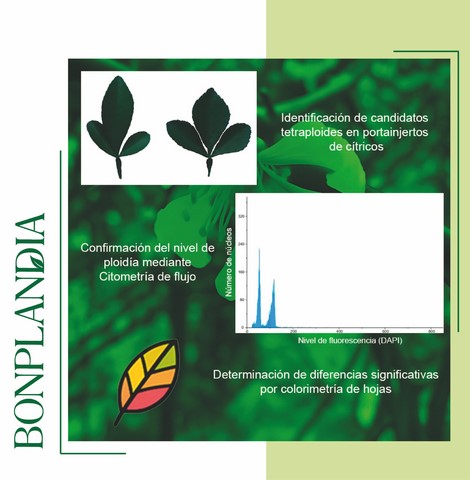
La citricultura en Argentina ocupa un lugar destacado a nivel mundial, con una producción concentrada principalmente en las regiones del noroeste argentino (NOA) y noreste argentino (NEA). El cultivo moderno de cítricos requiere el uso de portainjertos como herramienta esencial para mejorar la uniformidad, la productividad y la resistencia frente a condiciones adversas. Este estudio se centró en la identificación y selección de portainjertos tetraploides espontáneos a partir de cinco genotipos: ‘Trifolio Concordia’ [Poncirus trifoliata (L.) Raf.]; ‘Rubidoux’ (P. trifoliata); ‘X639’ (Citrus reshni Hort. ex Tanaka × P. trifoliata); ‘Citrange Troyer’ [C. sinensis (L.) Osbeck × P. trifoliata]; y ‘Citrumelo Swingle’ (Citrus paradisi Macfad. × P. trifoliata). A partir de la evaluación morfológica y la citometría de flujo, se confirmaron 13 plantas tetraploides entre 37 candidatos seleccionados. Los porcentajes variaron entre el 66,7% en ‘Rubidoux’ y el 12,5% en ‘Citrumelo Swingle’. La citometría demostró alta eficiencia en la detección, mientras que la colorimetría foliar permitió diferenciar diploides y tetraploides con variaciones destacadas en ‘X639’ (L* = 5.1; a* = –3.5; b* = 7.6). Estos hallazgos brindan herramientas clave para optimizar la selección de portainjertos en la citricultura moderna.
Descargas
Citas
Aleza, P., Juárez, J., Ollitrault, P. & Navarro, L. (2009a). Production of tetraploid plants of non apomictic citrus genotypes. Plant Cell Reports 28: 1837-1846. https://doi.org/10.1007/s00299-009-0783-2
Aleza, P., Juárez, J., Hernández, M., Pina, J.A., Ollitrault, P. & Navarro, L. (2009b). Recovery and characterization of a Citrus clementina Hort. ex Tan. “Clemenules” haploid plant selected to establish the reference whole Citrus genome sequence. BMC Plant Biology 9: 110. https://doi.org/10.1186/1471-2229-9-110
Aleza, P., Froelicher, Y., Schwarz, S., Agustí, M., Hernández, M. (2011). Tetraploidization events by chromosome doubling of nucellar cells are frequent in apomictic citrus and are dependent on genotype and environment. Annals of Botany 108: 37-50. https://doi.org/10.1093/aob/mcr099
Aleza, P., Juárez, J., Cuenca, J., Ollitrault, P. & Navarro, L. (2012a). Extensive citrus triploid hybrid production by 2x × 4x sexual hybridizations and parent-effect on the length of the juvenile phase. Plant Cell Reports 31: 1723-1735. https://doi.org/10.1007/s00299-012-1286-0
Aleza, P., Juárez, J., Hernández, M., Ollitrault, P. & Navarro, L. (2012b). Implementation of extensive citrus triploid breeding programs based on 4x × 2x sexual hybridisations. Tree Genetics & Genomes 8: 1293-1306. https://doi.org/10.1007/s11295-012-0515-6
Allario, T., Brumos, J., Colmenero-Flores, J. M., Tadeo & F., Froelicher, Y. (2011). Large changes in anatomy and physiology between diploid Rangpur lime (Citrus limonia) and its autotetraploid are not associated with large changes in leaf gene expression. Journal of Experimental Botany 62: 2507-2519. https://doi.org/10.1093/jxb/erq467
Arjona-López, J. M., Aparicio-Durán, L., Gmitter, F. G., Romero-Rodríguez, E., Grosser, J. W., Hervalejo, A. & Arenas-Arenas, F. J. (2023). Physiological influence of water stress conditions on novel hlb-tolerant citrus rootstocks. Agronomy 13: 1-10. https://doi.org/10.3390/agronomy13010063
Barrett, H. C. & Hutchison, D. J. (1978). Spontaneous tetraploidy in apomictic seedlings of Citrus. Economic Botany 32: 27-45. https://doi.org/10.1007/BF02906727
Bourge, M., Brown, S. C. & Siljak-Yakovlev, S. (2018). Flow cytometry as tool in plant sciences, with emphasis on genome size and ploidy level assessment. Genetics & Applications 2: 1. https://doi.org/10.31383/ga.vol2iss2pp1-12
Bowman, K. D. & Joubert, J. (2020). Citrus rootstocks. In The Genus Citrus. Elsevier Inc. https://doi.org/10.1016/B978-0-12-812163-4.00006-1
Cameron, J. W. & Frost, H. B. (1968). Genetic, breeding and nucellar embryony. En Reuther, W., Webber, H. J. & L. D. Batchelor (eds.), The citrus industry. University of California, Berkeley.
Caruso, M., Continella, A., Modica, G., Pannitteri, C. & Russo, R. (2020). Rootstocks influence yield precocity, productivity, and pre-harvest fruit drop of mandared pigmented mandarin. Agronomy 10: 1-12. https://doi.org/10.3390/agronomy10091305
Carvalho, S. A. & Silva, L. F. C. (2013). Monitoring the viability of citrus rootstocks seeds stored under refrigeration. Revista Brasileira de Fruticultura 35: 238-245. https://doi.org/10.1590/S0100-29452013000100027
Castle, W. S. (2010). A career perspective on citrus rootstocks, their development, and commercialization. HortScience 45: 11-15. https://doi.org/10.21273/HORTSCI.45.1.11
Cegelski, L. E., Beltrán, V. M., Gaiad, J. E., & Alayón Luaces, P. (2021). Evaluación de parámetros para la propagación de tres nuevos portainjertos híbridos de cítricos con potencial uso comercial. Bonplandia 30: 191-202. https://doi.org/10.30972/bon.3025105
Clydesdale, F. M. & Ahmed, E. M. (1978). Colorimetry-methodology and applications*. CRC Critical Reviews in Food Science and Nutrition 10: 243-301. https://doi.org/10.1080/10408397809527252
Comai, L. (2005). The advantages and disadvantages of being polyploid. Nature Reviews Genetics 6: 836-846. https://doi.org/10.1038/nrg1711
Cuenca, J., Garcia-Lor, A., Navarro, L. & Aleza, P. (2018). Citrus Genetics and Breeding. En Al-Khayri, J., Jain, S. & D. Johnson (eds.), Advances in Plant Breeding Strategies: Fruits, pp. 403-436. Springer, Cham. https://doi.org/10.1007/978-3-319-91944-7_11
Dambier, D., Benyahia, H., Pensabene-Bellavia, G., Aka Kaçar, Y., Froelicher, Y. (2011). Somatic hybridization for citrus rootstock breeding: an effective tool to solve some important issues of the Mediterranean citrus industry. Plant Cell Reports 30: 883-900. https://doi.org/10.1007/s00299-010-1000-z
Dewitte, A., Eeckhaut, T. Van Huylenbroeck, J. & Van Bockstaele, E. (2009). Occurrence of viable unreduced pollen in a Begonia collection. Euphytica 168: 81-94. https://doi.org/10.1007/s10681-009-9891-x
Dolezel, J., Doleželová, M. & Novák, F. J. (1994). Flow cytometric estimation of nuclear DNA amount in diploid bananas (Musa acuminata and M. balbisiana). Biologia Plantarum 36: 351-357. https://doi.org/10.1007/BF02920930
Dolezel, J., Greilhuber, J. & Suda, J. (2007). Estimation of nuclear DNA content in plants using flow cytometry. Nature Protocols 2: 2233-2244. https://doi.org/10.1038/nprot.2007.310
Dutt, M., Vasconcellos, M., Song, K. J., Gmitter, F. G. & Grosser, J. W. (2010). In vitro production of autotetraploid Ponkan mandarin (Citrus reticulata Blanco) using cell suspension cultures. Euphytica 173: 235-242. https://doi.org/10.1007/s10681-009-0098-y
FEDERCITRUS. (2024). La actividad citrícola. Federación Argentina del Citrus. www.federcitrus.org
Ferrante, S. P., Lucretti, S., Reale, S., De Patrizio, A., Abbate, L., Tusa, N. & Scarano, M. T. (2010). Assessment of the origin of new citrus tetraploid hybrids (2n = 4x) by means of SSR markers and PCR based dosage effects. Euphytica 173: 223-233. https://doi.org/10.1007/s10681-009-0093-3
Frost, H. B. & Soost, R. K. (1968). Seed reproduction: development of gametes and embryos. En Reuther, W., L. D. Batchelor & H. J. Webber (eds.), Citrus Industry: Anatomy, Physiology, Genetics and Reproduction, pp. 290-324. University of California.
Galbraith, D. W. (2010). Flow cytometry and fluorescence-activated cell sorting in plants: the past, present, and future. Biomédica 30: 65-70. https://doi.org/10.7705/biomedica.v30i0.824
Gallais, A. (2003). Quantitative genetics and breeding methods in autopolyploids plants. INRA, París.
García-Muñoz, M. C., Henao-Rojas, J. C., Moreno-Rodríguez, J. M., Botina-Azain, B. L.& Romero-Barrera, Y. (2021). Effect of rootstock and environmental factors on fruit quality of Persian lime (Citrus latifolia Tanaka) grown in tropical regions. Journal of Food Composition and Analysis, 103 (July). https://doi.org/10.1016/j.jfca.2021.104081
Gardner, J. L. (2007). Comparison of calibration methods for tristimulus colorimeters. Journal of Research of the National Institute of Standards and Technology 112: 129. https://doi.org/10.6028/jres.112.010
Gilchrist, A. & Nobbs, J. (2000). Colorimetry , Theory. En Lindon, J., Holmes, J. & G. Tranter, (eds.), Encyclopedia of Spectroscopy and Spectrometry (First, Issue January 2000), pp. 337-343. UK Academic Press.
González, M., Ghelfi, J., Rivas, F. & Bertalmio, A. (2013). Protocolo de producción de semilla certificada de portainjertos de citrus. Cartilla No 20: 1-3. http://www.ainfo.inia.uy/digital/bitstream/item/3822/1/Cartilla-20.pdf
Gora, J. S., Ram, C., Poonia, P. K., Choudhary, M. & Haldhar, S. M. (2022). Polyploid rootstocks in citrus for mitigation of biotic and abiotic stresses: A review. Journal of Agriculture and Ecology 13: 1-19. https://doi.org/10.53911/JAE.2022.13101
Gora, J. S., Kumar, R., Kumar, P., Ram, C., Berwal, M. K. & Haldhar, S. M. (2023). Citrus rootstocks for higher fruit yield production. En Singh, S. B., Haldhar, S. M., Dilip Singh, R. K., Thaochan, N. & A. A. Murkute, (eds.), Citrus Crop Production and Management in NEH Region, pp. 132-145. Scientific Publishers, Jodhpur (India).
Grosser, J. W., Ollitrault, P. & Olivares-Fuster, O. (2000). Invited review: Somatic hybridization in Citrus: An effective tool to facilitate variety improvement. In Vitro Cellular and Developmental Biology-Plant 36: 434-449. https://doi.org/10.1007/s11627-000-0080-9
Grosser, J. W., Gmitter, F. G. & Gmitter Jr. F. G. (2011). Protoplast fusion for production of tetraploids and triploids: applications for scion and rootstock breeding in citrus. Plant Cell, Tissue and Organ Culture (PCTOC) 104: 343-357. https://doi.org/10.1007/s11240-010-9823-4
Guerra, D., Wittmann, M. T. S., Schwarz, S. F., Souza, P. V. D., Gonzatto, M. P. & Weiler, R. L. (2014). Comparison between diploid and tetraploid citrus rootstocks: morphological characterization and growth evaluation. Bragantia 73: 1-7. https://doi.org/10.1590/brag.2014.007
Guerra, D., Schifino-Wittmann, M. T., Schwarz, S. F. Weiler, R. L., Dahmer, N. & De Souza, P. V. D. (2016). Tetraploidization in citrus rootstocks: Effect of genetic constitution and environment in chromosome duplication. Crop Breeding and Applied Biotechnology 16: 35-41. https://doi.org/10.1590/1984-70332016v16n1a6
Heslop-Harrison, J. S. & Schwarzacher, T. (1996). Flow cytometry and chromosome sorting. En Fukui, K. & S. Nakayama (eds.), Plant Chromosomes: Laboratory Methods, pp. 85-108. CRC Press, Boca Raton.
Hussain, S., Curk, F., Ollitrault, P., Morillon, R. & Luro, F. (2011). Facultative apomixis and chromosome doubling are sources of heterogeneity in citrus rootstock trials: Impact on clementine production and breeding selection. Scientia Horticulturae 130: 815-819. https://doi.org/10.1016/j.scienta.2011.09.009
Hussain, S., Curk, F., Anjum, M. A., Pailly, O. & Tison, G. (2013). Performance evaluation of common clementine on various citrus rootstocks. Scientia Horticulturae 150: 278-282. https://doi.org/10.1016/j.scienta.2012.11.010
Jaskani, M. J., Khan, M. M. & Khan, I. A. (2002). Growth, morphology and fruit comparison of diploid and tetraploid Kinnow mandarin. Pakistan Journal of Agricultural Sciences 39: 126-128.
Khan, I. A., & Roose, M. L. (1988). Frequency and characteristics of nucellar and zygotic seedlings in three cultivars of trifoliate orange. Journal of the American Society for Horticultural Science 113: 105-110. https://doi.org/10.21273/JASHS.113.1.105
Kishore, K., Monika, D., Rinchen, L. B. & Pandey, B. (2012). Polyembryony and seedling emergence traits in apomictic citrus. Scientia Horticulturae 138: 101-107. https://doi.org/10.1016/j.scienta.2012.01.035
Latado, R. R., Cristofani-Yaly, M., Carvalho, C. R. & Machado, M. A. (2007). Plantas autotetraplóides de citros sob tratamento in vitro com colchicina. Pesquisa Agropecuária Brasileira 42: 1429-1435. https://doi.org/10.1590/s0100-204x2007001000009
Lee, L. S. (1988). Citrus polyploidy - origins and potential for cultivar improvement. Australian Journal of Agricultural Research 39: 735-747. https://doi.org/10.1071/AR9880735
Oiyama, I. & Okudai, N. (1986). Production of colchicine-induced autotetraploid plants through micrografting in monoembryonic citrus cultivars. Japanese Journal of Breeding 36: 371-376. https://doi.org/10.1270/jsbbs1951.36.371
Ollitrault, P. & Michaux-Ferrière, N. (1992). Application of flow cytometry for citrus genetic and breeding. International Citrus Congress. 7: 20.
Ollitrault, P., Dambier, D. , Sudahono, L. F. (1996a). Somatic hybridisation in citrus: some new hybrid and alloplasmic plants. En Proceedings International Society Citriculture. Volume 2. s.l.: s.n., 907-912. International Citrus Congress. 8, Sun City, Afrique du Sud, 12 Mai 1996/17 Mai 1996.
Ollitrault, P., Dambier, D., Jacquemond, C., Allent, V. & Luro, F. (1996b). In vitro rescue and selection of spontaneous triploids by flow cytometry for easy peeler citrus breeding. Proceedings International Society Citriculture 2: 254-258.
Ollitrault, P., Dambier, D. S., Mademba-Sy, F., Vanel, F., Luro, F. & Aubert, B. (1999). Biotechnology for triploid mandarin breeding. 5th World Congress of the International Society of Citrus Nurserymen. Proceedings of the Congress, p. 337.
Ollitrault, P., Dambier, D., Luro, F. & Froelicher, Y. (2008). Ploidy manipulation for breeding seedless triploid citrus. En Janick, J. (ed.), Plant Breeding Reviews, pp. 323-352. John Wiley & Sons, Inc. https://doi.org/10.1002/9780470380130.ch7completar editores
Ollitrault, P., Germanà, M. A., Froelicher, Y., Cuenca, J., Aleza, P., Morillon, R.; Grosser, J. D.; Guo, W. (2020). Ploidy manipulation for Citrus breeding, genetics, and genomics. En Gentile, A., La Malfa, S. & Z. Deng (eds.). The Citrus Genome, pp. 75-105. Springer, Cham. https://doi.org/10.1007/978-3-030-15308-3_6
Otto, S. P. & Whitton, J. (2000). Polyploid incidence and evolution. Annual Review of Genetics 34: 401-437. https://doi.org/10.1146/annurev.genet.34.1.401
Peer, Y.V.D., Mizrachi, E., Marchal, K., Van de Peer, Y., Mizrachi, E. & Marchal, K. (2017). The evolutionary significance of polyploidy. Nature Reviews Genetics 18: 411-424. https://doi.org/10.1038/nrg.2017.26
Podda, A., Checcucci, G., Mouhaya, W., Centeno, D. & Rofidal, V. (2013). Salt-stress induced changes in the leaf proteome of diploid and tetraploid mandarins with contrasting Na+ and Cl− accumulation behaviour. Journal of Plant Physiology 170: 1101-1112. https://doi.org/10.1016/j.jplph.2013.03.006
Ramos, S., De Ruyver, R., Gattinoni, N., Garín, R. & Garrán, S. (2018). Estación agrometeorológica del INTA Concordia. Serie de extensión.
Romero-Aranda, R., Bondada, B. R., Syvertsen, J. P. & Groser, J. W. (1997). Leaf characteristics and net gas exchange of diploid and autotetraploid Citrus. Annals of Botany 79: 153-160. https://doi.org/10.1006/anbo.1996.0326
Ruiz, M., Quiñones, A., Martínez-Alcántara, B., Aleza, P., Morillon, R. (2016a). Tetraploidy enhances boron-excess tolerance in Carrizo Citrange (Citrus sinensis L. Osb. × Poncirus trifoliata L. Raf.). Frontiers in Plant Science 7(May): 1-16. https://doi.org/10.3389/fpls.2016.00701
Ruiz, M., Quiñones, A., Martínez-Alcántara, B., Aleza, P. & Morillon, R. (2016b). Effects of salinity on diploid (2x) and doubled diploid (4x) Citrus macrophylla genotypes. Scientia Horticulturae 207: 33-40. https://doi.org/10.1016/j.scienta.2016.05.007
Saleh, B., Allario, T., Dambier, D., Ollitrault, P. & Morillon, R. (2008). Tetraploid citrus rootstocks are more tolerant to salt stress than diploid. Comptes Rendus Biologies 331: 703-710. https://doi.org/10.1016/j.crvi.2008.06.007
Sanford, J. C. (1983). Ploidy manipulations. En Moore, J. N. & J. Janick (eds.), Methods in Fruit Breeding (1st ed.), pp. 100-123. Purdue University Press.
Schepper, S. De, Leus, L., Mertens, M., Bockstaele, E. Van & Melle, B. (2001). Flow Cytometric analysis of ploidy in Rhododendron (subgenus Tsutsusi). HortScience 36: 125-127.
Seker, M., Tuzcu, O. & Ollitrault, P. (2003). Comparison of nuclear DNA content of citrus rootstock populations by flow cytometry analysis. Plant Breeding 122: 169-172. https://doi.org/10.1046/j.1439-0523.2003.00821.x
Sliwinska, E. (2018). Flow cytometry- a modern method for exploring genome size and nuclear DNA synthesis in horticultural and medicinal plant species. Folia Horticulturae 30: 103-128. https://doi.org/10.2478/fhort-2018-0011
Descargas
Publicado
Cómo citar
Número
Sección
Licencia
Derechos de autor 2025 Bonplandia

Esta obra está bajo una licencia internacional Creative Commons Atribución 4.0.
Declaration of Adhesion to Open Access
- All contents of Bonplandia journal are available online, open to all and for free, before they are printed.
Copyright Notice
- Bonplandia magazine allows authors to retain their copyright without restrictions.
- The journal is under a Creative Commons Attribution 4.0 International license.










.jpg)