
Living hedges in three neighborhood contexts of Comodoro Rivadavia, Chubut: composition, uses, and invasive species
DOI:
https://doi.org/10.30972/bon.3619378Keywords:
Exotic species, NUS, ornamental plants, Patagonian Atlantic coast, urban floraAbstract
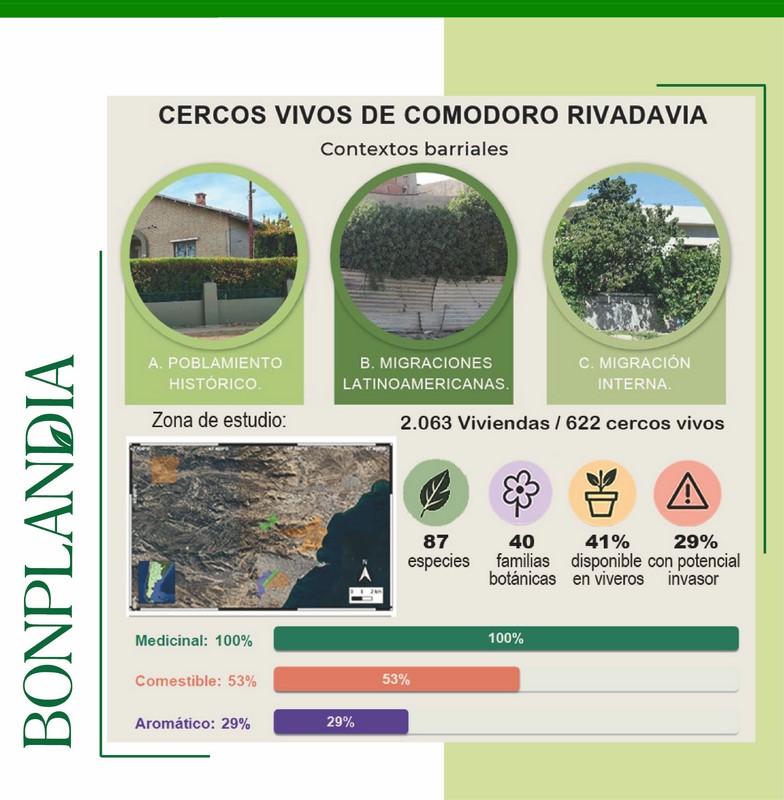
Urban residential living hedges are relevant components of urban flora, but they have been poorly studied along the Patagonian Atlantic coast. This study characterized the plant composition of front-yard living hedges in Comodoro Rivadavia and explored their potential uses and the risks associated with species exhibiting invasive behavior. A total of 2063 households were surveyed, of which 622 had living hedges, across three neighborhood contexts defined according to different historical trajectories of settlement and socio-spatial differentiation. Eighty-seven species belonging to 40 botanical families were recorded, with a predominance of exotic species (87%). Species richness per hedge differed among neighborhood contexts, being higher in the context characterized by historical settlement. Forty-one percent of the recorded species were also found in the commercial supply of local nurseries, whereas numerous species present in living hedges were not recorded in this supply. The literature review documented medicinal, edible, and aromatic uses and allowed 40% of the species to be classified as NUS (Neglected and Underutilized Species). In addition, 29% of the species had documented invasive behavior, with differences among neighborhood contexts. These results provide a baseline for characterizing urban living hedges in coastal Patagonia and contribute information relevant to their management and planning.
Downloads
References
Albuquerque, U. P., Maroyi, A., Ladio, A. H., Pieroni, A., Abbasi, A. M., Arias Toledo, B. A., Dahdouh-Guebas, F., ... et al. (2024). Advancing ethnobiology for the ecological transition and a more inclusive and just world: a comprehensive framework for the next 20 years. Journal of Ethnobiology and Ethnomedicine 20: 18. https://doi.org/10.1186/s13002-024-00661-4
Angiosperm Phylogeny Group. (2016). An update of the Angiosperm Phylogeny Group classification for the orders and families of flowering plants: APG IV. Botanical Journal of the Linnean Society 181: 1-20. https://doi.org/10.1111/boj.12385
Avolio, M. L., Pataki, D. E., Trammell, T. L. & Endter-Wada, J. (2018). Biodiverse cities: the nursery industry, homeowners, and neighborhood differences drive urban tree composition. Ecological Monographs 88: 259-276. https://doi.org/10.1002/ecm.1290
Baeza, B. (2008a). Migración y mercado laboral petrolero. En Ciselli, G. & A. Enrici (comps.), El viaje de los dioses: Migración, creencias y folklore en Comodoro Rivadavia. Comodoro Rivadavia: Vela al Viento Ediciones Patagónicas.
Baeza, B. (2008b). La experiencia de los migrantes bolivianos en Comodoro Rivadavia (Chubut). Diferenciaciones, identificaciones e interacción con la sociedad comodorense. IX Congreso Argentino de Antropología Social. Facultad de Humanidades y Ciencias Sociales. Universidad Nacional de Misiones, Posadas.
Baeza, B. (2014). “Toma de tierras” y crecimiento urbano en Comodoro Rivadavia: diferenciaciones y tensiones entre migrantes limítrofes, internos y comodorenses. Párrafos Geográficos 13: 76-107.
Baeza, B. & Lago, L. (2015). Expansión urbana, religiosidad católica y “barrios chilenos” en Comodoro Rivadavia (1950-1973). En Nicoletti, M. A., P. Núñez & A. Núñez (eds.), Araucanía-Norpatagonia III. Discursos y representaciones de la materialidad, pp. 209-231. Editorial UNRN, Bariloche.
Baldermann, S., Blagojevic, L., Frede, K., Klopsch, R., Neugart, S., Neumann, A., Ngwene, B., ... et al. (2016). Are Neglected Plants the Food for the Future?. Critical Reviews in Plant Sciences 35: 106-119. https://doi.org/10.1080/07352689.2016.1201399
Barrientos, E., Molares, S. & Rovere, A. (2025). Plantas para cercos comercializadas en una ciudad costera de la Patagonia extra-Andina (Argentina): atributos de selección e implicancias para la conservación. Boletín de la Sociedad Argentina de Botánica 60: 171-190. https://doi.org/10.31055/1851.2372.v60.n2.47680
Bele, A. & Chakradeo, U. (2021). Public perception of biodiversity: A literature review of its role in urban green spaces. Journal of Landscape Ecology 14. https://doi.org/10.2478/jlecol-2021-0008
Betancurt, R., Rovere, A. & Ladio, A. (2017). Incipient Domestication Processes in Multicultural Contexts: A Case Study of Urban Parks in San Carlos de Bariloche (Argentina). Frontiers in Ecology and Evolution 5: 166. https://doi.org/10.3389/fevo.2017.00166
Blanusa, T., Garratt, M. P., Wallace, S., Sadler, J. & Hiscock, K. (2019). Urban hedges: A review of plant species and cultivars for ecosystem service delivery in north-west Europe. Urban Forestry & Urban Greening 44: 126391. https://doi.org/10.1016/j.ufug.2019.126391
Cabrera, A. & Willink, A. (1973). Biogeografía de América Latina. Monografía 13. Serie de Biología. Secretaria General de la OEA. Programa Regional de Desarrollo Científico y Tecnológico, Washington DC.
Caetano, C., Peña C., Maigual J., Vásquez., L., Caetano Nunes, D., & Pazdiora, B. (2015). Mejoramiento participativo: herramienta para la conservación de cultivos subutilizados y olvidados. Acta Agronómica 64: 307-327. https://doi.org/10.15446/acag.v64n3sup.50550
Ceballos, S. J., Saravia, A. N., Foguet, J., Jimenez, Y., González, M. V., Coria, G., ... et al. (2025). The legacy of neighborhood age: how the past shapes the current diversity, composition, and cover of urban trees. Urban Ecosystems 28: 99. https://doi.org/10.1007/s11252-025-01705-7
Ciselli, G. & Enrici, A. (2008). El viaje de los Dioses. Migración, creencias y folklore en Comodoro Rivadavia. Comodoro Rivadavia: Vela al Viento Ediciones Patagónicas.
Ciselli, G. & Hernández, M. (Dirs. y Comps.). (2018). Diadema: Historia urbana y herencia industrial. Tomo II. Biblioteca Popular Astra, Comodoro Rivadavia.
Ciselli, G. & Hernández, M. (Dirs. y Comps.). (2019). General Mosconi: Un lugar con identidad petrolera. Tomo III. Biblioteca Popular Astra, Comodoro Rivadavia.
Cooper, C., Collier, M., Pineda-Pinto, M., Castañeda, N., O’Donnell, M. & Nulty, F. (2024). Urban novel ecosystems as affective landscapes. Sustainability Science 19: 1921-1933. https://doi.org/10.1007/s11625-024-01539-w
Correa, M. N. (1969-1999). Flora Patagónica, partes I-VIII. Colección Científica del INTA, Buenos Aires.
Cui, J., Sharifi, E., Bartesaghi Koc, C., Yi, L. & Hawken, S. (2025). Factors shaping biodiversity in urban voids: A systematic literature review. Land 14: 821. https://doi.org/10.3390/land14040821
de Barros Ruas, R., Baião, M., Biondi, D. & Ceschin, F. (2022). Urbanization driving changes in plant species and traits: A systematic review. Urban Forestry & Urban Greening 68: 127494.
Diazgranados, M., Allkin, B., Black, N., Cámara-Leret, R., & Canteiro, C. (2020). World Checklist of Useful Plant Species. Royal Botanic Gardens, Kew. https://doi.org/10.5063/F1CV4G34
Draper, D. & Marques, I. (2022). Aprovechando el potencial de las especies desatendidas y subutilizadas para mejorar la seguridad alimentaria. Agronomía 12: 3138. https://doi.org/10.3390/agronomy12123138
FAO. (2018). Especies de cultivos marginadas e infrautilizadas. Comité de Agricultura. 26° período de sesiones. Roma, Italia. Food and Agriculture Organization of the United Nations. https://www.fao.org/3/mx479es/mx479es.pdf
Francis, R. A. & Chadwick, M. A. (2015). Urban invasions: non-native and invasive species in cities. Geography 100: 144-151. https://doi.org/10.1080/00167487.2015.12093969
Freddo, B. V. (2018). Urbanización y territorio fragmentado: El mapa social de Comodoro Rivadavia–Argentina, 2010. Geografía y Sistemas de Información Geográfica 10: 226-238.
García de León, D., Benayas, J. & Andivia, E. (2021). Contributions of hedgerows to people: A global meta-analysis. Frontiers in Conservation Science 2: 789612. https://doi.org/10.3389/fcosc.2021.789612
Hardberger, A., Craig, D., Simpson, C., Cox, R. & Perry, G. (2025). Greening up the city with native species: challenges and solutions. Diversity 17: 56. https://doi.org/10.3390/d17010056
Hernández Bermejo, J. E. (2022). Cultivos marginados e infrautilizados (NUS). Fundación de Estudios Rurales Anuario 2022: 141-151.
Hirtz, N. (2000). Carta Geoambiental de Comodoro Rivadavia. Chubut. Informe final. Universidad Nacional de la Patagonia San Juan Bosco. Secretaría Ciencia y Técnica, Comodoro Rivadavia.
Horvat, E., Šipek, M. & Šajna, N. (2024). Urban hedges facilitate spontaneous woody plants. Urban Forestry & Urban Greening 96: 128336. https://doi.org/10.1016/j.ufug.2024.128336
Hu, R., Xu, C., Nong, Y. & Luo, B. (2023). Changes in homegardens in relocation villages, a case study in the Baiku Yao area in Southern China. Journal of Ethnobiology and Ethnomedicine 19: 7. https://doi.org/10.1186/s13002-023-00578-4
Ilie, D. & Cosmulescu, S. (2023). Spontaneous plant diversity in urban contexts: A review of its impact and importance. Diversity 15: 734. https://doi.org/10.3390/d15020277
InBiAr. (2022). Base de Datos sobre Invasiones Biológicas en Argentina. GEKKO, Grupo de Estudios en Conservación y Manejo. Universidad Nacional del Sur. Bahía Blanca, Argentina. Disponible en: http://www.inbiar.uns.edu.ar.
INDEC. Instituto Nacional de Estadística y Censos. 2022 [online]. Disponible en: https://www.indec.gob.ar/
Kemat, N. & Man, N. (2023). Consumers’ preference in online purchasing of ornamental plants in the Klang Valley, Malaysia. Malaysian Journal of Agricultural Economics 30: 1-25. https://doi.org/10.36877/mjae.a0000436
Knuth, M. J., Behe, B. K., Rihn, A. & Hall, C. R. (2023). Effects of benefits messaging on consumer purchasing of plants. HortScience 58: 481-487. https://doi.org/10.21273/HORTSCI16993-22
Kujawska, M. & Jiménez-Escobar, N. (2023). Shaping garden landscape with medicinal plants by migrant communities in the Atlantic Forest, Argentina. Ethnobotany Research and Applications 25: 1-20. https://doi.org/10.5751/ES-14633-280414
Lazo Rojas, B. (2025). Potencial invasor de plantas ornamentales comercializadas en el Gran Concepción. Tesis de pregrado, Universidad de Concepción. Repositorio Universidad de Concepción. Disponible en: https://repositorio.udec.cl/handle/11594/12412
López-Almirall, A., Duarte, S. & Machon, N. (2025). Plant diversity and uses in urban domestic gardens of Regla, Havana, Cuba. Urban Ecosyst 28: 164. https://doi.org/10.1007/s11252-025-01774-8
MAyDS. 2021. Res. 109/2021 (Ministerio de Ambiente y Desarrollo Sustentable de la Nación). Lista de especies exóticas invasoras, potencialmente invasoras y criptogénicas de la República Argentina [online]. Disponible en: https://www.argentina.gob.ar/normativa/nacional/norma-348718
Molares, S. & Rovere, A. (2016). Plantas medicinales, comestibles y aromáticas en cercos vivos de una ciudad patagónica de Argentina: características y potencialidades de un recurso poco explorado. Boletín Latinoamericano y del Caribe de Plantas Medicinales y Aromáticas 15: 41-52.
Molares, S., Ciampagna, M. & Ladio, A. (2023). Digestive plants in a Mapuche community of the Patagonian steppe: multidimensional variables that affect their knowledge and use. Ethnobotany Research and Application 25: 1-19. http://dx.doi.org/10.32859/era.25.17.1-19
Moyano Estrada, E. (2021). ¿Y si el futuro estuviera en los cultivos NUS? Diario Rural. Disponible en: http://eldiariorural.es/y-si-el-futuro-estuviera-en-los-cultivos-nus/
Municipalidad de Comodoro Rivadavia. (2018). Código de ordenamiento urbano de Comodoro Rivadavia. Chubut. Disponible en: https://www.mininterior.gov.ar/planificacion/pdf/planes-loc/CHUBUT/Codigo-Urbano-Comodoro-Rivadavia.pdf
Municipalidad de Comodoro Rivadavia. (2022). Perfil de la ciudad. Disponible en: https://www.comodoro.gov.ar/miciudad/2022/08/03/perfil-de-la-ciudad/
Neulinger, K., Vogl, C. & Alayón-Gamboa, J. A. (2013). Plant species and their uses in homegardens of migrant Maya and mestizo smallholder farmers in Calakmul, Campeche, Mexico. Journal of Ethnobiology 33: 105-124. http://dx.doi.org/10.2993/0278-0771-33.1.105
Öopik, M., Bunce, R. & Tischler, M. (2013). Horticultural markets promote alien species invasions: an Estonian case study of herbaceous perennials. NeoBiota 17: 19-37. https://doi.org/10.3897/neobiota.17.4217
Organización Mundial de la Salud. (2023). Primera Cumbre Mundial de la OMS sobre Medicina Tradicional. Disponible en: https://www.who.int/es/news-room/events/detail/2023/08/17/default-calendar/the-first-who-traditional-medicine-global-summit
Oyarzabal, M., Clavijo, J., Oakley, L., Biganzoli, F., Tognetti, P., Barberis, I., Maturo, H. M., ... et al. (2018). Unidades de vegetación de la Argentina. Ecología Austral 28: 40-63. https://doi.org/10.25260/EA.18.28.1.0.399
Padulosi, S., Thompson, J. & Rudebjer, P. G. (2013). Fighting poverty, hunger and malnutrition with neglected and underutilized species (NUS): needs, challenges and the way forward. Bioversity International, Rome. https://doi.org/10.13140/RG.2.1.3494.3842
Pedraza Zamora, G., Avendaño-Reyes, S., Coates, R., Gómez Díaz, J. A., Lascurain, M., García-Guzmán, G. ... et al. (2022). Live fences as refuges of wild and useful plant diversity: their drivers and structure in five elevation contrast sites of Veracruz, Mexico. Tropical Conservation Science 15. https://doi.org/10.1177/19400829221078489
Pickett, S. T., Cadenasso, M. L., Grove, J. M., Boone, C. G., Groffman, P. M., Irwin, E., Kaushal, S. S., ... et al. (2011). Urban ecological systems: Scientific foundations and a decade of progress. Journal of Environmental Management 92: 331-362. https://doi.org/10.1016/j.jenvman.2010.08.022
Pradeiczuk, A., Eichemberg, M. & Kissmann, C. (2017). Urban ethnobotany: a case study in neighborhoods of different ages in Chapecó, Santa Catarina State. Acta Botanica Brasilica 31: 276-285. https://doi.org/10.1590/0102-33062017abb0080
Purba, N. & Krishnaswamy, K. (2025). Exploring the potentials of neglected underutilized crops (NUCs): an integrative review for developing a sustainable food system model. npj Science of Food 9: 199. https://doi.org/10.1038/s41538-025-00554-0
Rapoport, E. H., Sanz, E. H. & Ladio, A. H. (2001). Plantas silvestres comestibles de la Patagonia argentino-chilena. Parte I. Ediciones Alternatura. National Geographic Society, UNC, Bariloche, Argentina.
Rapoport, E. H., Ladio, A. H. & Sanz, E. (2003). Plantas Nativas Comestibles de la Patagonia andina argentino-chilena. Parte II. Ediciones Alternatura. Secretaría de Extensión Universitaria. UNC. Fundación Antorchas, Bariloche, Argentina.
Rapoport, E. H., Ladio, A. H. & Sanz, E. (2011). Plantas Silvestres Comestibles de la Patagonia andina argentino-chilena. Exóticas. Parte I. Ediciones Alternatura. Secretaría de Extensión Universitaria, UNC, Bariloche, Argentina.
Rovere, A., Molares, S. & Ladio, A. (2013). Plantas utilizadas en cercos vivos de ciudades patagónicas: aportes de la etnobotánica para la conservación. Ecología Austral 23: 165-173. https://doi.org/10.25260/EA.13.23.3.0.1171
Rovere, A., Molares, S. & Ladio, A. (2015). Cercos vivos en la flora de una ciudad de la patagonia semiárida argentina: especies preferidas e implicancias para la restauración ecológica. En Martínez Carretero, E. & A. D. Dalmasso (eds.), Restauración Ecológica en la Diagonal Árida de la Argentina 2, pp. 429-442. IADIZA, Mendoza.
Salomón, M. (2015). Desarrollo local, migraciones y desarraigo: la agricultura periurbana en Comodoro Rivadavia como testimonio de la voluntad transformadora de los desarraigados. Tesis de posgrado Universidad Nacional del Sur, Argentina.
Sifanele, L., Shackleton, C. & Ziter, C. (2025). Homestead hedges as potential sources of alien invasive and poisonous plants in rural and urban communities, South Africa. Ecosystems and People 21: 2583992. https://doi.org/10.1080/26395916.2025.2583992
Specha, V. & Aráoz, E. (2024). Socio-economic differences control species composition of urban gardens in a metropolitan area of Argentina. Tropical Ecology 65: 142-151. https://doi.org/10.1007/s42965-023-00293-x
Tejedo, A., Pereyra, F., Anielli, C. & Jones, M. (2000). Comodoro Rivadavia. Provincia de Chubut. Programa Nacional de Cartas Geológicas de la República Argentina. 1:250.000. Boletín; 305. Buenos Aires, Subsecretaría de Minería de la Nación.
Torres, A. P., Rihn, A. L., Barton, S. S. & Behe, B. K. (2024). Perceptions and socioeconomic status influence purchases of native plants. HortTechnology 34: 153-160. https://doi.org/10.21273/HORTTECH05345-23
Ulian, T., Diazgranados, M., Pironon, S., Padulosi, S., Liu, U., Davies, L., Howes, M. J. R., ... et al. (2020). Unlocking plant resources to support food security and promote sustainable agriculture. Plants, People, Planet 2: 421-445. https://doi.org/10.1002/ppp3.10145
Usach, N. & Freddo, B. (2015). Crecimiento de una ciudad dispersa: análisis y reflexiones del caso de la ciudad de Comodoro Rivadavia. Informes Científicos Técnicos-UNPA 7: 219-243. https://doi.org/10.22305/ict-unpa.v7i1.122
Vacarezza, M., Rovere, A. E., Riat, M., Sánchez, G. & Tello, B. (2017). Rotondas viales en Bariloche. En Burgueño, G. & C. Nardini (eds.), Diseño de espacios verdes sustentables con plantas nativas, pp. 132-135. Editorial Albatros, Ciudad Autónoma de Buenos Aires.
van Kleunen, M., Essl, F., Pergl, J., Brundu, G., Carboni, M., Dullinger, S., Early, R., ... et al. (2018). The changing role of ornamental horticulture in plant invasions. Biological reviews of the Cambridge Philosophical Society 93: 1421-1437. https://doi.org/10.1111/brv.12402
Woldeyohannes, A. & Moges, A. (2024). Biodiversity and structural analysis of woody plant species of home gardens in Basona Worana district, North Shoa Zone of Central Ethiopia. Scientifica 5563636. https://doi.org/10.1155/2024/5563636
Yinebeb, M., Lulekal, E. & Bekele, T. (2022). Composition of homegarden plants and cultural use in an indigenous community in Northwest Ethiopia. Journal of Ethnobiology and Ethnomedicine 18: 47. https://doi.org/10.1186/s13002-022-00545-5
Zuloaga, F. O., Zanotti, C. A. & Salariato, D. L. (2025). Actualización del Catálogo de Plantas Vasculares del Cono Sur II. Darwiniana, Nueva Serie 13: 189-244. https://doi.org/10.14522/darwiniana.2025.131.1301
Downloads
Published
How to Cite
Issue
Section
License
Copyright (c) 2026 Bonplandia

This work is licensed under a Creative Commons Attribution 4.0 International License.
Declaration of Adhesion to Open Access
- All contents of Bonplandia journal are available online, open to all and for free, before they are printed.
Copyright Notice
- Bonplandia magazine allows authors to retain their copyright without restrictions.
- The journal is under a Creative Commons Attribution 4.0 International license.