
Floristic and taxonomic notes on Najas (Hydrocharitaceae) in Argentina
DOI:
https://doi.org/10.30972/bon.3428443Palavras-chave:
Alismatales, hydrophytes, Najas major, Najas marinaResumo
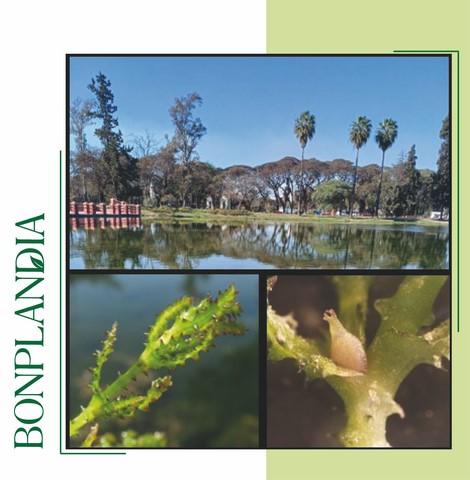
Najas is a cosmopolitan genus belonging to the family Hydrocharitaceae; Najas marina is a submerged aquatic herbaceous species, with prickly stems and leaves, living in fresh or brackish waters of shallow lakes. The aim of this work was to report the presence of N. marina in an urban lake in the city of San Miguel de Tucumán (Tucumán, Argentina), being the first record of the genus in northwestern Argentina. Previous reports of N. marina in Argentina included the provinces of Corrientes, Mendoza, Misiones, San Luis and Santa Fe. Specimens collected in the northeast of the country (provinces of Corrientes and Santa Fe) previously cited as N. marina correspond to Najas major, characterized by having unarmed stems and leaves.
Downloads
Referências
Agami, M. & Waisel, Y. (1986). The role of mallard ducks (Anas platyrhynchos) in distribution and germination of seeds of the submerged hydrophyte Najas marina L. Oecologia 68: 473-475.
Bräuchler, C. (2015). Towards a better understanding of the Najas marina complex: Notes on the correct application and typification of the names N. intermedia, N. major, and N. marina. Taxon 64: 1028-1030.
Brumnich, F. & Schneider, B. (2020). Primer registro de Najas marina (Hydrocharitaceae) y listado florístico de hidrófitas sumergidas en el Bajo Paraná (Argentina). Lilloa 57: 13-35. doi.org/10.30550/j.lil/2020.57.1/2
Flora Argentina (2025). http://www.floraargentina. edu.ar/ (Accessed 5 May, 2025).
Guido, E. Y. & Sesma, P. J. (2014). Geografía física. En Moyano, S., Puchulu, M. E., Fernández, D., Aceñolaza, G., Vides, M. E.& S. Nieva (eds.), Geología de Tucumán, pp. 29-48. Colegio de Graduados en Ciencias Geológicas de Tucumán, Tucumán.
Haynes, R. R. (1979). Revision of North and Central American Najas (Najadaceae). Sida 8: 34-56.
Hunziker, A. T. (1966). Adiciones al conocimiento de la Flora del Centro de Argentina. I. Najas marina. Kurtziana 3: 221-231. La Gaceta (22 de octubre de 2018). Editorial: La recuperación del lago San Miguel. Recuperado de https://www.lagaceta.com.ar/nota/787301/opinion/ recuperacion-lago-san-miguel.html.
Les, D. H., Moody, M. L. & Soros, C. L. (2006). A reappraisal of phylogenetic relationships in the monocotyledon Family Hydrocharitaceae (Alismatidae). Aliso 22: 211-230.
Lowden, R. M. (1986). Taxonomy of the genus Najas L. (Najadaceae) in the Neotropics. Aquatic Botany 24: 147-184.
Mori, S. A., Silva, L. A. M., Lisboa, G. & Coradin, L. (1989). Manual de manejo do herbário fanerogâmico. Centro de Pesquisas do Cacau, Ilhéus.
Pérez, A. A., Zaccagnini, M. E. & Pereda, A. J. (2011). La influenza aviar y sus implicancias para la salud de las aves silvestres de américa del sur. Hornero 26: 29-44.
Rüegg, S., Raeder, U., Melzer, A., Heubl, G. & Bräuchler, C. (2017). Hybridization and cryptic invasion in Najas marina L. (Hydrocharitaceae)? Hydrobiologia 784: 381-395. 10.1007/s10750-016- 2899-z
Taboada, M. de los A. & Bustos, M. S. (2020). Informe técnico: Relevamiento Fitoplanctónico del Lago San Miguel. Municipalidad de S. M. de Tucumán, Tucumán
Talavera, S. & Gallego, M. J. (2010). Najas L. En Talavera, S., Gallego, M. J., Romero Zarco, C. & A. Herrero (eds.), Flora Iberica XVII. Butomaceae-Juncaceae, pp. 55-62. Consejo Superior de Investigaciones Científicas, Madrid.
Tarver, D. P., Rogers, J. A., Mahler, M. J. & Lazor, R. L. (1986). Aquatic and Wetland Plants of Florida. Florida Department of Natural Resources, Tallahassee, Florida.
Thiers, B. (2025). Index Herbariorum: A global directory of public herbaria and associated staff. New York Botanical Garden’s Virtual Herbarium. http://sweetgum.nybg.org/ih/ (Accessed 5 May, 2025).
Triest, L. (1987). A revision of the genus Najas L. (Najadaceae) in Africa and surrounding islands. Mémoires de l’Académie Royale des Sciences d’Outre-Mer. Classe des Sciences Naturelles et Médicales (NS) 21: 1-89.
Triest, L. (1988). A revision of the genus Najas L. (Najadaceae) in the Old World. Mémoires de l’Académie Royale des Sciences d’Outre-Mer. Classe des Sciences Naturelles et Médicales (NS) 22: 1-172.
Triest, L. (1989). Electrophoretic polymorphism and divergence in Najas marina L. (Najadaceae): Molecular markers for individuals, hybrids, cytodemes, lower taxa, ecodemes and conservation of genetic diversity. Aquatic Botany 33: 301-380. http://dx.doi.org/10.1016/0304-3770(89)90043-0
Triest, L. (1991). ADH polymorphism in Najas marina (Najadaceae): The situation in an obligate outcrosser. Opera Botanica Belgica 4: 171-198.
Triest, L., Van Geyt, J. & Ranson, V. (1986). Isozyme polymorphism in several populations of Najas marina L. Aquatic Botany 24: 373-384. http:// dx.doi.org/10.1016/0304-3770(86)90103-8
Urquiola Cruz, A. J., Vega Hernández, E., Novo Carbó, R. & López, M. L. (1998). Las Najadaceae de Cuba. Anales del Jardín Botánico de Madrid 56: 85-94.
Viinikka, Y. (1976). Najas marina L. (Najadaceae): karyotypes, cultivation and morphological variation. Annales Botanici Fennici 13: 119-131.
Viinikka, Y. (1977). The role of U-type exchanges in the differentiation of karyotypes of Najas marina. Hereditas 86: 91-102. http://dx.doi. org/10.1111/j.1601-5223.1977.tb01215.x
Wang, Q. F., Youhao, G., Haynes, R. R. & Hellquist, C. B. (2010). Hydrocharitaceae. En Wu, Z.& P. H. Raven (eds.), Flora of China 23: Acoraceae through Cyperaceae, pp. 91-102. Science Press & Missouri Botanical Garden Press Beijing & St. Louis.
Whyte, R. J. & Silvy, N. J. (1981). Effects of cattle on duck food plants in southern Texas. Journal of Wildlife Management 45: 51-515.
Downloads
Publicado
Versões
- 2025-08-14 (2)
- 2025-07-08 (1)
Como Citar
Edição
Seção
Licença
Copyright (c) 2025 Bonplandia

Este trabalho está licenciado sob uma licença Creative Commons Attribution 4.0 International License.
Declaration of Adhesion to Open Access
- All contents of Bonplandia journal are available online, open to all and for free, before they are printed.
Copyright Notice
- Bonplandia magazine allows authors to retain their copyright without restrictions.
- The journal is under a Creative Commons Attribution 4.0 International license.








.jpg)