
Evaluación de nombres históricos de Andreaea del noroeste argentino clarifica la taxonomía de las especies ecostadas de Andreaea en los Andes centrales
DOI:
https://doi.org/10.30972/bon.3619744Palabras clave:
Andreaeaceae, briófitas, nomenclatura, taxonomía, tipificaciónResumen
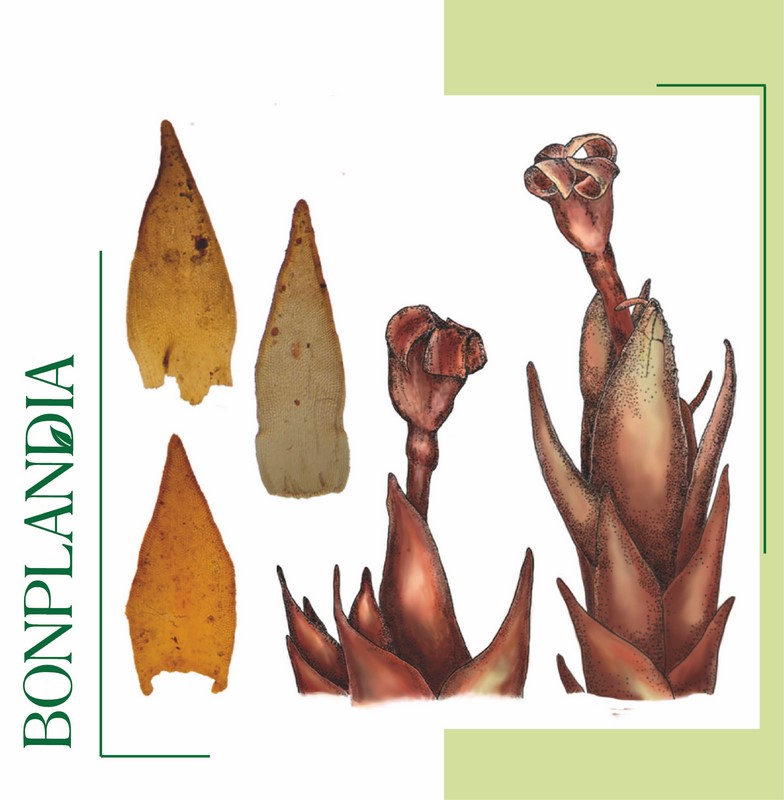
El género Andreaea Hedw. permanece escasamente conocido en la región andina de Sudamérica, donde la delimitación de especies se ha basado históricamente en caracteres morfológicos altamente variables. En este trabajo se revisó críticamente el material tipo de Andreaea arachnoidea, A. lorentziana, A. fragilis y A. semisquarrosa, descriptos por Müller para el noroeste argentino a partir de colecciones realizadas por Lorentz durante el siglo XIX. El estudio de los ejemplares conservados en JE demostró que estos nombres no representan taxones distintos, sino que corresponden respectivamente a A. rupestris, A. mutabilis y A. acutifolia. La variación morfológica observada entre los ejemplares estudiados involucra principalmente el hábito, el patrón de ramificación, la orientación foliar y el grado de acuminación de las hojas, caracteres fuertemente influenciados por las condiciones ambientales de los ecosistemas altoandinos. La reinterpretación de A. arachnoidea mostró además que las estructuras aracnoideas mencionadas en el protólogo corresponden a hifas fúngicas asociadas a los gametofitos y no a caracteres intrínsecos del musgo. Las sinonimias propuestas contribuyen a clarificar la taxonomía de Andreaea en Sudamérica y refuerzan las afinidades florísticas entre los Andes centrales y las floras briológicas austro-templadas. Se designan lectotipos para todos los nombres estudiados.
Descargas
Citas
Anderson, L. E. (1954). Hoyer’s solution as a rapid permanent mounting medium for bryophytes. The Bryologist 57: 242-244. https://doi.org/10.2307/3240091
Churchill, S. P., Sanjines, A. N. & Aldana, M. C. (2009). Catálogo de las briofitas de Bolivia: diversidad, distribución y ecología. Missouri Botanical Garden.
Churchill, S. P. & Linares C., E. L. (1995). Prodromus Bryologiae Novo-Granatensis: Introducción a la flora de musgos de Colombia. Biblioteca José Jerónimo Triana 12: 1-924.
Crosby, M. R., Magill, R. E., Allen, B. & He, S. (1999). A Checklist of the Mosses. Missouri Botanical Garden, St. Louis.
Flores, J. R., Von Konrat, M., Larraín, J. & Suárez, G. M. (2017). Disjunct or continuous? On the distributional pattern of Cephaloziella hampeana (Nees) Schiffn. ex Loeske (Cephaloziellaceae, Marchantiophyta) in South America. Cryptogamie, Bryologie 38: 53-59. https://doi.org/10.7872/cryb/v38.iss1.2017.53
Frey, W. & Stech, M. (2009) Marchantiophyta, Bryophyta, Anthocerotophyta. In Frey, W. (ed.), Syllabus of Plant Families, pp. 13-263. A. Engler’s Syllabus der Pflanzenfamilien, 13th ed., Part 3 Bryophytes and seedless Vascular Plants. Gebr. Borntraeger Verlagsbuchhandlung, Stuttgart.
Herzog, T. (1916). Die Bryophyten meiner zweiten Reise durch Bolivia. Bibliotheca Botanica 87: 1-347.
Jimenez M. S., Schiavone, M. M., Suárez, G. M. & Delgadillo, C. (2015). Neosharpiella aztecorum H. Rob. & Delgad. (Gigaspermaceae), new to the bryophyte flora of South America. Cryptogamie, Bryologie 36: 69-74. https://doi.org/10.7872/cryb.v36.iss1.2015.69
Matteri, C. M. (2003). Los musgos (Bryophyta) de Argentina. Tropical Bryology 24: 33-100. https://doi.org/10.11646/bde.24.1.8
Matteri, C. M. & Schiavone, M. M. (2002). Catálogo de los musgos (Bryophyta) de la Región Fueguina en Argentina y Chile. Revista del Museo Argentino de Ciencias Naturales 4: 111-138.
Murray, B. M. (1988). Systematics of the Andreaeopsida (Bryophyta): two orders with links to Takakia. Beiheft Nova Hedwigia 90: 289-336.
Murray, B. M. (1988b). The genus Andreaea in Britain and Ireland. Journal of Bryology 15: 17-82. https://doi.org/10.1179/jbr.1988.15.1.17
Murray, B. (2006). Andreaeaceae. In Flora of Australia Volume 51 (Mosses 1). ABRS and CSIRO Publishing, Canberra & Melbourne.
Müller, C. (1879). Prodromus bryologiae Argentinicae I. Linnaea 42: 217-460.
Müller, F. (2009). An updated checklist of the mosses of Chile. Archive for Bryology 58: 1-124.
Novara, L. J. (1983). Paul Lorentz, Max Siewert, Georg Hieronymus tres sabios en Salta. El Tribuno 6-8.
Peralta, D. F. (2020). The genus Andreaea Hedw. (Andreaeaceae, Bryophyta) in Brazil. Phytotaxa 451: 169-174. https://doi.org/10.11646/phytotaxa.451.2.7
Schiavone, M. M. & Suárez, G. M. (2009). Globulinella halloyi (Pottiaceae), a new species from Argentina. The Bryologist 112: 584-588. https://doi.org/10.1639/0007-2745-112.3.584
Suárez, G. M. (2024). Taxonomical status of Andreaea clavata var. tenuior Broth. (Bryophyta, Andreaeaceae). Phytotaxa 642: 225-228. https://doi.org/10.11646/phytotaxa.642.3.2
Suárez G. M. & Schiavone M. M. (2011). A taxonomic revision of the propaguliferous species of Pohlia (Bryaceae, Bryophyta) in Latin America. Lilloa 48: 217-249.
Suárez G. M. & Hentschel, J. (2024). Lectotypification of Andreaea vilocensis (Andreaeaceae, Bryophyta). Lindbergia 2024: 1-3. https://doi.org/10.25227/linbg.025139
Suárez, G. M., Larraín, J. & Schiavone, M. M. (2013). Rediscovery and lectotypification of Dicranella lorentzii (Dicranellaceae, Bryophyta). Boletín de la Sociedad Argentina de Botánica 48: 53-57. https://doi.org/10.31055/1851.2372.v48.n1.52096
Turland, N.J., Wiersema, J.H., Barrie, F.R., Gandhi, K.N., Gravendyck, J., Greuter, W., ...et al. (2025). International Code of Nomenclature for algae, fungi, and plants (Madrid Code). University of Chicago Press. https://doi.org/10.7208/chicago/9780226839479.001.0001
Vitt, D. H. (1980). A comparative study of Andreaea acutifolia, A. mutabilis, and A. rupestris. New Zealand Journal of Botany 18: 367-377. https://doi.org/10.1080/0028825X.1980.10427254
Descargas
Publicado
Cómo citar
Número
Sección
Licencia
Derechos de autor 2026 Bonplandia

Esta obra está bajo una licencia internacional Creative Commons Atribución 4.0.
Declaration of Adhesion to Open Access
- All contents of Bonplandia journal are available online, open to all and for free, before they are printed.
Copyright Notice
- Bonplandia magazine allows authors to retain their copyright without restrictions.
- The journal is under a Creative Commons Attribution 4.0 International license.