
Glomeromycota en musgos: estructuras micorrícicas arbusculares en Leptodontium capituligerum (Pottiaceae) del Chaco Serrano argentino
DOI:
https://doi.org/10.30972/bon.3529542Palabras clave:
Bryophyta, Glomeromycota, hongos, hongos micorrícicos arbusculares, musgos, Pottiaceae, simbiosisResumen
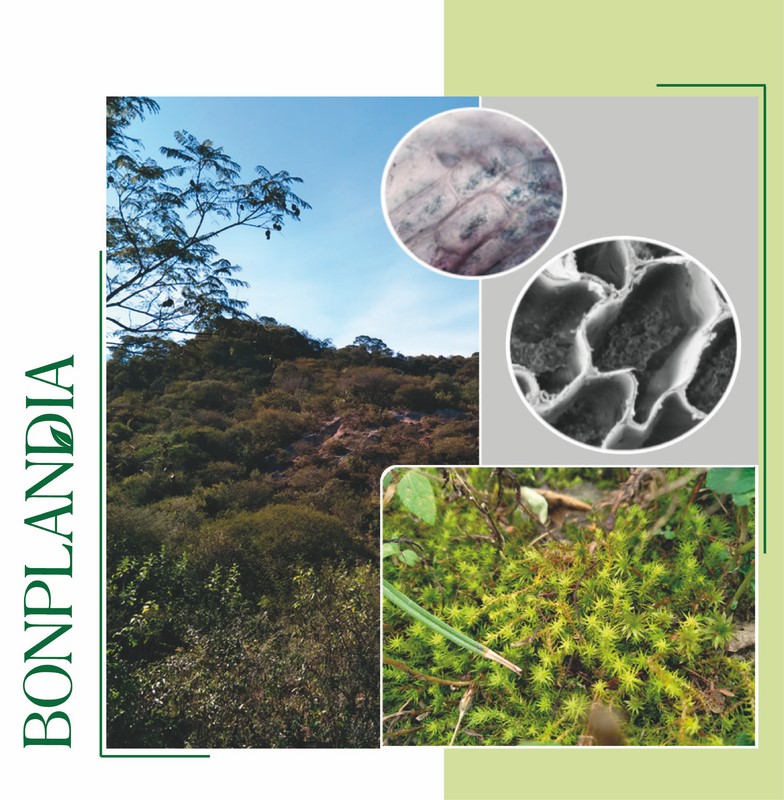
Las asociaciones entre hongos micorrícicos arbusculares (HMA) y musgos están escasamente documentadas en comparación con las registradas para otros grupos de briófitas. El objetivo de este trabajo es describir estructuras fúngicas compatibles con Glomeromycota en gametófitos vivos de Leptodontium capituligerum (Pottiaceae) provenientes del Chaco Serrano de Tucumán, Argentina. Los gametófitos se aclararon con KOH, se tiñeron con azul de tripano y se examinaron mediante microscopía óptica y electrónica de barrido. En hojas y tallos se observaron hifas aseptadas intercelulares, ovillos hifales intracelulares, arbúsculos, vesículas y esporas morfológicamente compatibles con HMA. Se detectaron patrones de colonización de tipo Arum y Paris. Adicionalmente, se registraron endófitos septados oscuros y otros hongos septados asociados con hojas y rizoides. Estos hallazgos aportan evidencia sobre la presencia de simbiosis fúngicas complejas en Bryophyta y refuerzan la hipótesis de que las asociaciones con Glomeromycota son más frecuentes de lo asumido tradicionalmente en musgos.
Descargas
Citas
ALBORNOZ, P. L., CATANIA, M. dEL V. & SUÁREZ, G. M. (2022). Presencia de micorrizas arbusculares y endófitos septados en Plagiochasma rupestre (Aytoniaceae, Marchantiophyta) del Chaco Serrano (Tucumán, Argentina). Lilloa 59: 189-197. https:// doi.org/10.30550/j.lil/2022.59.2/2022.08.10
CATANIA, M. dEL V., ALBORNOZ, P. L., RAUSCH, A. O., LEDESMA, T. M., DONg, S., CAI, Y., ZENg, Y ET Al. (2025). Discovery of arbuscular mycorrhizae in mosses of the Pottiaceae family from the Chaco Serrano (Tucumán, Argentina). Plants 14: 1048. https://doi.org/10.3390/plants14071048
COTTET, A. C., SCERVINO, J. M. & MESSUTI, M. I. (2018). An improved staining protocol for the assessment of arbuscular mycorrhizal in bryophytes. Boletín de la Sociedad Argentina de Botánica 53: 201-206. https:// doi.org/10.31055/1851.2372.V53.N2.20577
DICKSON, S. (2004). The Arum-Paris continuum of mycorrhizal symbioses. New Phytologist 163: 187-200. https://doi.org/10.1111/j.1469-8137.2004.01095.x
GERDEMANN J. W. (1968). Vesicular-arbuscular mycorrhiza and plant growth. Annual Review of Phytopathology 6: 397-418.
GodoY, R., AgUILERA, P., RETAMAL, J., GUZMÁN RIFFO, E., Fox, L. J., CooPER, A. M., MARTínEZ MANZANO, C. & MARín, C. (2026). Spores of arbuscular mycorrhizal fungi inhabiting the insides of mossballs formed by Rigodium implexum. microPublication Biology. https://doi.org/10.17912/micropub. biology.001982
HARLEY, J. L. (1969). The biology of mycorrhiza, 2nd edn. Leonard Hill, London.
KELLEY, A. P. (1950). Mycotrophy in plants. Lectures on the biology of mycorrhizae and related structures. Chronica Botanica Co.: Waltham, MA, USA.
KELLY, K. H., COLEINE, C., COSHLAND, C. & STAJICH, J. E. (2026). Novel Glomeromycotina-moss associations identified in California dryland biocrusts. New Phytologist. https://doi.org/10.1111/nph.71211
LAVADO, R. S. & CHIOCCHIO, V. M. (2025). Mycorrhizal and endophytic fungi as a tool for sustainable environments. Plants 14: 2581. https://doi. org/10.3390/plants14162581
PRESSEL, S., BIDARTONDO, M. I., LIgRONE, R. & DUCKETT, J. G. (2010). Fungal symbioses in bryophytes: new insights in the twenty first century. Phytotaxa 9: 238- 253. https://doi.org/10.11646/phytotaxa.9.1.13
RAYNER M. C. (1927). Mycorrhiza. Wheldon and Wesley, London.
READ, D. J., DUCKETT, J. G., FRANCIS, R., LIgRONE, R. & RUSSELL, A. (2000). Symbiotic fungal associations in “lower” land plants. Philosophical Transactions of the Royal Society B 355: 815-831. https://doi. org/10.1098/rstb.2000.0617
SCHENCK, N. C. & PéREZ, Y. (1990). Manual for the identification of vesicular–arbuscular mycorrhizal fungi. INVAM, University of Florida, Gainesville.
SCHüSSLER, A., SCHYARZOTT, D. & WALKER, C. (2001) A new fungal phylum, the Glomeromycota: phylogeny and evolution. Mycological Research 105: 1413-1421. https://doi.org/10.1017/S0953756201005196
ZANDER, R. H. (1972). Revision of the genus Leptodontium (Musci) in the New World. The Bryologist 75: 213-280. https://doi.org/10.2307/3241464
ZANDER, R. H. (1993). Genera of the Pottiaceae: mosses of harsh environments. Bulletin of the Buffalo Society of Natural Sciences 32: 1-378.
Descargas
Publicado
Cómo citar
Número
Sección
Licencia

Esta obra está bajo una licencia internacional Creative Commons Atribución 4.0.
Declaration of Adhesion to Open Access
- All contents of Bonplandia journal are available online, open to all and for free, before they are printed.
Copyright Notice
- Bonplandia magazine allows authors to retain their copyright without restrictions.
- The journal is under a Creative Commons Attribution 4.0 International license.










.jpg)