
Glomeromycota in mosses: arbuscular mycorrhizal structures in Leptodontium capituligerum (Pottiaceae) from the Argentine Chaco Serrano
DOI:
https://doi.org/10.30972/bon.3529542Palavras-chave:
Arbuscular mycorrhizal fungi, Bryophyta, Glomeromycota, mosses, Pottiaceae, symbiosisResumo
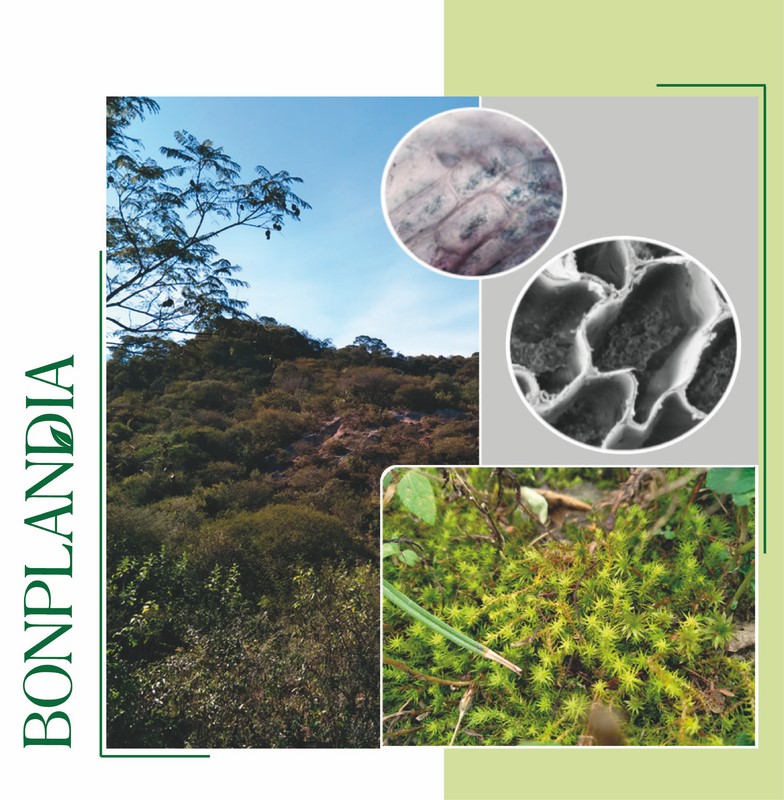
Arbuscular mycorrhizal fungi (AMF) associations in mosses remain poorly documented compared with those reported for liverworts and hornworts. In this contribution, we report fungal structures compatible with Glomeromycota in living gametophytes of Leptodontium capituligerum (Pottiaceae) from the Chaco Serrano of Tucumán, Argentina. Gametophytes were clarified with KOH, stained with trypan blue, and examined using light and scanning electron microscopy. Intercellular aseptate hyphae, intracellular hyphal coils, arbuscules, vesicles, and spores morphologically compatible with AMF were observed in leaves and stems. Both Arumand Paris-type morphologies were detected. In addition, dark septate endophytes and other septate fungi were associated with leaves and rhizoids. These observations provide additional evidence supporting fungal symbioses in mosses and reinforce the hypothesis that associations between Bryophyta and Glomeromycota may be more frequent than previously assumed.
Downloads
Referências
ALBORNOZ, P. L., CATANIA, M. dEL V. & SUÁREZ, G. M. (2022). Presencia de micorrizas arbusculares y endófitos septados en Plagiochasma rupestre (Aytoniaceae, Marchantiophyta) del Chaco Serrano (Tucumán, Argentina). Lilloa 59: 189-197. https:// doi.org/10.30550/j.lil/2022.59.2/2022.08.10
CATANIA, M. dEL V., ALBORNOZ, P. L., RAUSCH, A. O., LEDESMA, T. M., DONg, S., CAI, Y., ZENg, Y ET Al. (2025). Discovery of arbuscular mycorrhizae in mosses of the Pottiaceae family from the Chaco Serrano (Tucumán, Argentina). Plants 14: 1048. https://doi.org/10.3390/plants14071048
COTTET, A. C., SCERVINO, J. M. & MESSUTI, M. I. (2018). An improved staining protocol for the assessment of arbuscular mycorrhizal in bryophytes. Boletín de la Sociedad Argentina de Botánica 53: 201-206. https:// doi.org/10.31055/1851.2372.V53.N2.20577
DICKSON, S. (2004). The Arum-Paris continuum of mycorrhizal symbioses. New Phytologist 163: 187-200. https://doi.org/10.1111/j.1469-8137.2004.01095.x
GERDEMANN J. W. (1968). Vesicular-arbuscular mycorrhiza and plant growth. Annual Review of Phytopathology 6: 397-418.
GodoY, R., AgUILERA, P., RETAMAL, J., GUZMÁN RIFFO, E., Fox, L. J., CooPER, A. M., MARTínEZ MANZANO, C. & MARín, C. (2026). Spores of arbuscular mycorrhizal fungi inhabiting the insides of mossballs formed by Rigodium implexum. microPublication Biology. https://doi.org/10.17912/micropub. biology.001982
HARLEY, J. L. (1969). The biology of mycorrhiza, 2nd edn. Leonard Hill, London.
KELLEY, A. P. (1950). Mycotrophy in plants. Lectures on the biology of mycorrhizae and related structures. Chronica Botanica Co.: Waltham, MA, USA.
KELLY, K. H., COLEINE, C., COSHLAND, C. & STAJICH, J. E. (2026). Novel Glomeromycotina-moss associations identified in California dryland biocrusts. New Phytologist. https://doi.org/10.1111/nph.71211
LAVADO, R. S. & CHIOCCHIO, V. M. (2025). Mycorrhizal and endophytic fungi as a tool for sustainable environments. Plants 14: 2581. https://doi. org/10.3390/plants14162581
PRESSEL, S., BIDARTONDO, M. I., LIgRONE, R. & DUCKETT, J. G. (2010). Fungal symbioses in bryophytes: new insights in the twenty first century. Phytotaxa 9: 238- 253. https://doi.org/10.11646/phytotaxa.9.1.13
RAYNER M. C. (1927). Mycorrhiza. Wheldon and Wesley, London.
READ, D. J., DUCKETT, J. G., FRANCIS, R., LIgRONE, R. & RUSSELL, A. (2000). Symbiotic fungal associations in “lower” land plants. Philosophical Transactions of the Royal Society B 355: 815-831. https://doi. org/10.1098/rstb.2000.0617
SCHENCK, N. C. & PéREZ, Y. (1990). Manual for the identification of vesicular–arbuscular mycorrhizal fungi. INVAM, University of Florida, Gainesville.
SCHüSSLER, A., SCHYARZOTT, D. & WALKER, C. (2001) A new fungal phylum, the Glomeromycota: phylogeny and evolution. Mycological Research 105: 1413-1421. https://doi.org/10.1017/S0953756201005196
ZANDER, R. H. (1972). Revision of the genus Leptodontium (Musci) in the New World. The Bryologist 75: 213-280. https://doi.org/10.2307/3241464
ZANDER, R. H. (1993). Genera of the Pottiaceae: mosses of harsh environments. Bulletin of the Buffalo Society of Natural Sciences 32: 1-378.
Downloads
Publicado
Como Citar
Edição
Seção
Licença

Este trabalho está licenciado sob uma licença Creative Commons Attribution 4.0 International License.
Declaration of Adhesion to Open Access
- All contents of Bonplandia journal are available online, open to all and for free, before they are printed.
Copyright Notice
- Bonplandia magazine allows authors to retain their copyright without restrictions.
- The journal is under a Creative Commons Attribution 4.0 International license.










.jpg)