
Leaf anatomy of Argentine species of Typha (Typhaceae), its usefulness as a taxonomic tool
DOI:
https://doi.org/10.30972/bon.3528947Keywords:
fiber cables, leaf anatomy, taxonomy, TyphaAbstract
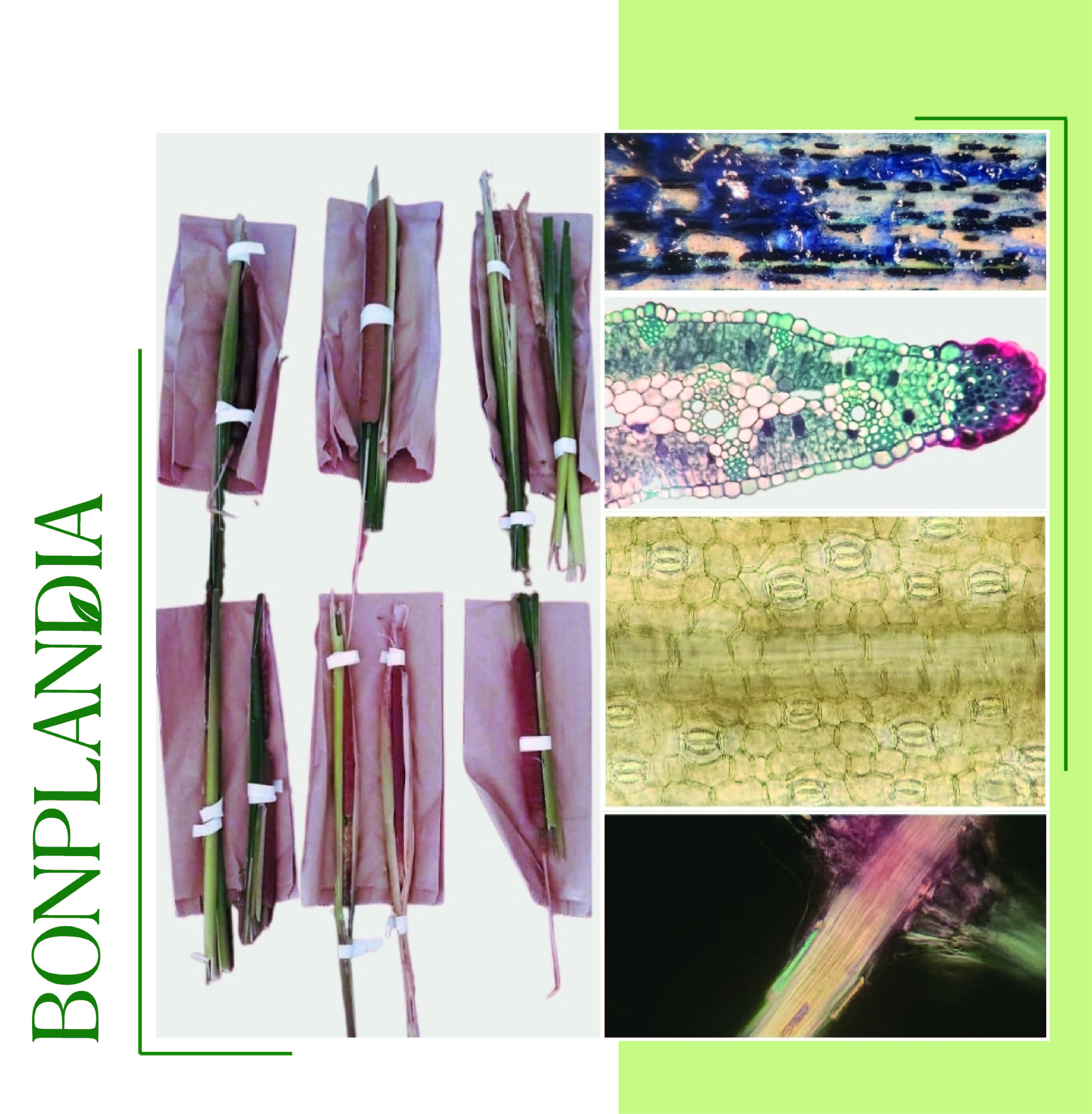
Typha includes plants typical of wetlands distributed across temperate and tropical regions around the world. Its taxonomic identification requires the simultaneous observation of characters from male and female inflorescences, which is a significant challenge since they do not mature at the same time. In this study, the leaf anatomy of T. domingensis, T. latifolia, T. laxmannii, and T. subulata was analyzed in order to identify characters that contribute to their taxonomic identification in vegetative stage. Conventional plant histology techniques were used. Typha domingensis and T. subulata have pseudosunken stomata, while T. latifolia and T. laxmannii have the stomata at epidermal level. Typha domingensis and T. subulata have triangular fiber caps at leaf margin, while in T. latifolia they are rounded and they are absent in T. laxmannii. The air cavities are oval in transversal section, in T. domingensis and T. laxmannii their major axis is perpendicular to the leaf surface and in T. latifolia and T. subulata it is parallel to it. Fiber cables are absent only in T. laxmannii. These results provide useful tools for the taxonomic identification of Typha species in the absence of reproductive structures.
Downloads
References
Akhtar, N., Hameed, M., Nawaz, F., Ahmad, K. S., Hamid, A., Segovia-Salcedo, C. & Shahnaz, M. M. (2017). Leaf anatomical and biochemical adaptations in Typha domingensis Pers. ecotypes for salinity tolerance. Botanical Sciences 95: 807-821. https://doi.org/10.17129/botsci.886
APG. Angiosperm Phylogeny Group. (2009). An update of the Angiosperm Phylogeny Group classification for the orders and families of flowering plants: APG III. Botanical Journal of the Linnean Society 161: 105-121. https://doi.org/10.1111/j.1095-8339.2009.00996.x
Crespo, S. & Pérez-Moreau, R. L. (1967). Revisión del género Typha en la Argentina. Darwiniana 14: 413-429.
Corrêa, F. F., Madail, R. H., Barbosa, S., Pereira, M. P., Castro, E. M., Soriano, C. T. G. & Pereira, F. J. (2015). Anatomy and physiology of cattail as related to different population densities. Planta Daninha 33: 1-12. https://doi.org/10.1590/S0100-83582015000100001
D’Ambrogio de Argüeso, A. (1986). Manual de técnicas en histología vegetal. Hemisferio Sur, Buenos Aires.
Fahn, A. (1978). Anatomía vegetal. H. Blume Ediciones, Madrid.
Franceschi, V. R. & Nakata, P. A. (2005). Calcium oxalate in plants: Formation and function. Annual Review of Plant Biology 56: 41-71. https://doi.org/10.1146/annurev.arplant.56.032604.144106
Franco, M. F., Medici, S. K., Okada, E. & Pérez, D. J. (2020). Biorremediación de aguas contaminadas por actividades agropecuarias: Uso de la planta acuática Typha spp. (totora) como organismo fitorremediador. INTA. http://hdl.handle.net/20.500.12123/11172
Gatusso, M. A. & Gatusso, S. J. (1999). Manual de procedimientos para el análisis de drogas en polvo. UNR Editora, Rosario.
Horner, H. T. (1981). Growth and change in shape of raphide and druse calcium oxalate crystals as function of intracellular development in Typha angustifolia L. (Typhaceae) and Capsicum annuum L. (Solanaceae). Scanning Electron Microscopy 3: 251-262.
Johansen, D. A. (1940). Plant microtechnique. McGraw-Hill, New York.
Kaul, R. B. (1974). Ontogeny of foliar diaphragms in Typha latifolia. American Journal of Botany 61: 318-323. https://doi.org/10.1002/j.1537-2197.1974.tb10780.x
Liu, J., Zhang, Z., Yu, Z., Liang, Y., Li, X. & Ren, L. (2017). The structure and flexural properties of Typha leaves. Applied Bionics and Biomechanic 1249870: 1-9. https://doi.org/10.1155/2017/1249870
McManus, H. A., Seago, J. L. & Marsh, L. C. (2002). Epifluorescent and histochemical aspects of shoot anatomy of Typha latifolia, Typha angustifolia and Typha glauca. Annals of Botany 90: 489-493. https://doi.org/10.1093/aob/mcf211
Pérez Cuadra, V. & Cambi, V. N. (2014). Ocurrencia de caracteres anatómicos funcionales foliares y caulinares en 35 especies xero-halófilas. Boletín de la Sociedad Argentina de Botánica 49: 347-359. https://doi.org/10.31055/1851.2372.v49.n3.9465
Pozner, R. (2024). Typha. En A. M. Anton & F. O. Zuloaga (Dirs.), Flora Argentina. http://www.floraargentina.edu.ar
Tosif, M. M., Najda, A., Bains, A., Kaushik, R., Dhull, S. B., Chawla, P. & Walasek-Janusz, M. (2021). A comprehensive review on plant-derived mucilage: Characterization, functional properties, applications, and its utilization for nanocarrier fabrication. Polymers 13: 1066. https://doi.org/10.3390/polym13071066
Venning, F. D. (1954). Manual of advanced plant microtechnique. Wm. C. Brown Company, Dubuque.
Villagra, P. E., Giordano, C., Álvarez, J. A., Bruno Cavagnaro, J., Guevara, A., Sartor C., & Greco, S. (2011). Ser planta en el desierto: Estrategias de uso de agua y resistencia al estrés hídrico en el Monte Central de Argentina. Ecología Austral 21: 29-42.
Villamil, C. B. & Scoffield, R. (2022). Flora del partido de Villarino: Provincia de Buenos Aires, Argentina (1.ª ed.). Ediuns, Bahía Blanca.
Witztum, A. & Wayne, R. (2014). Fibre cables in the lacunae of Typha leaves contribute to a tensegrity structure. Annals of Botany 113: 789-797. https://doi.org/10.1093/aob/mcu002
Zuñiga, D. J. (2005). Estudios de biomineralización del oxalato de calcio en plantas superiores. Tesis doctoral, Universidad Nacional Autónoma de México. 80pp.
Downloads
Published
How to Cite
Issue
Section
License
Copyright (c) 2026 Bonplandia

This work is licensed under a Creative Commons Attribution 4.0 International License.
Declaration of Adhesion to Open Access
- All contents of Bonplandia journal are available online, open to all and for free, before they are printed.
Copyright Notice
- Bonplandia magazine allows authors to retain their copyright without restrictions.
- The journal is under a Creative Commons Attribution 4.0 International license.










.jpg)