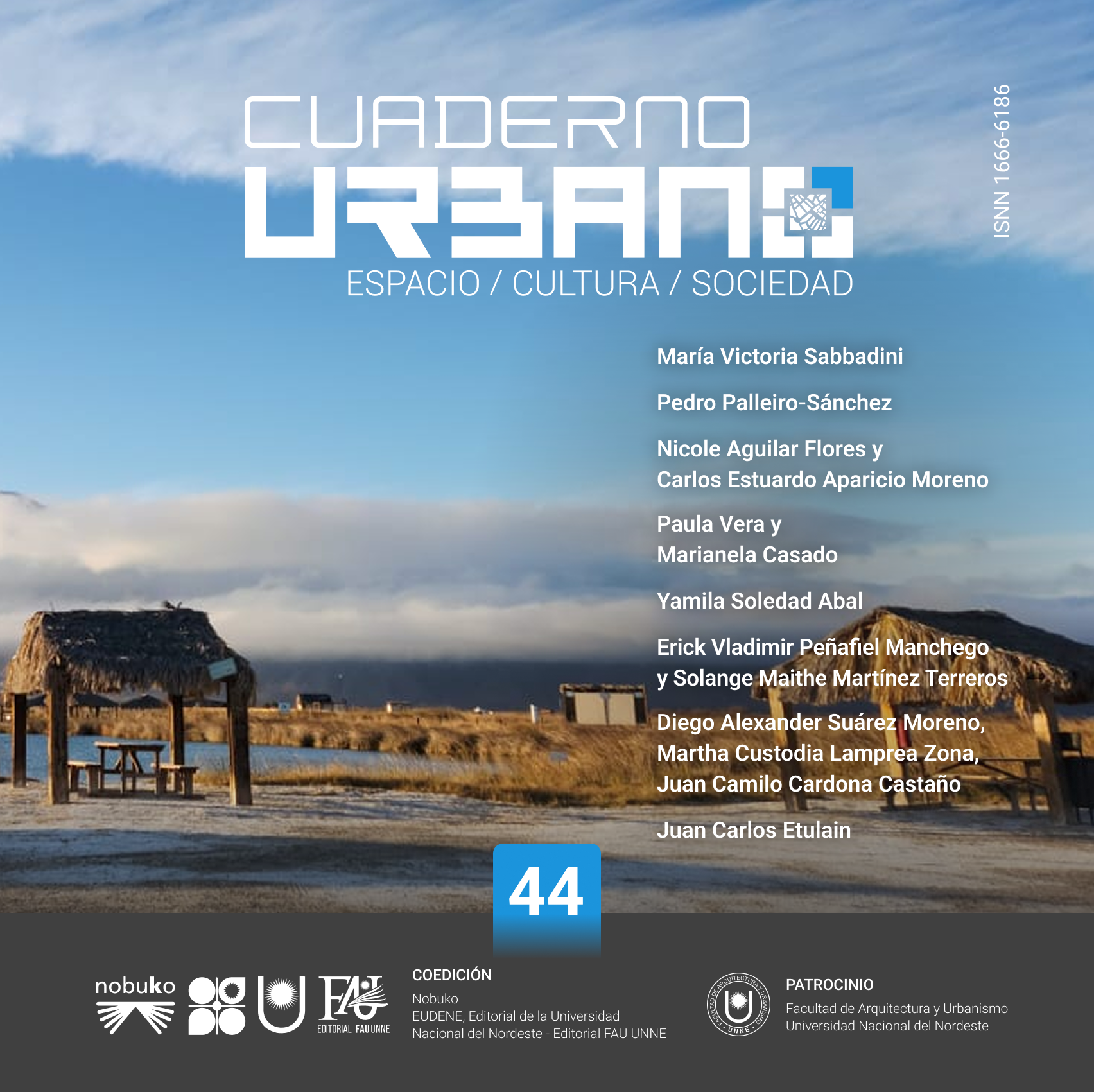
Patterns of territorial change in the Cuatro Ciénegas, Coahuila, protected natural area: historical cartographic reconstruction
DOI:
https://doi.org/10.30972/crn.44449595Keywords:
Cuatro Ciénegas, territorial management, urban growth, aquatic ecosystemsAbstract
The Cuatro Ciénegas Valley, in Coahuila, Mexico, consists of a network of interconnected water bodies that have historically sustained both biodiversity and human settlement. This research analyzes patterns of territorial change through a historical-cartographic reconstruction of the valley’s natural and built environments, integrating environmental data, satellite imagery, and historical sources. Based on two axes of analysis—the evolution of aquatic ecosystems and urban footprint growth—stages
of territorial overlap and conflict that have transformed Cuatro Ciénegas over time are identified. The results reveal a transition toward a degraded hydrological system linked to agricultural, tourism, and urban processes, as well as a disconnect between population growth and land consumption, accompanied by a continuous increase in water pressure. These findings highlight the need for comprehensive territorial management.
Downloads
References
Alimonda, H. (2011). La naturaleza colonizada: Ecología política y minería en América Latina. CLACSO.
Azuela, A. (2006). Visionarios y pragmáticos: Una aproximación sociológica al derecho ambiental. Universidad Nacional Autónoma de México.
Bertrand, G. (1978). Le paysage entre la nature et la société. Revue Géographique des Pyrénées et du Sud-Ouest, 49(2), 239–258.
Boisier, S. (2004). Desarrollo territorial y descentralización. El desarrollo en el lugar y en las manos de la gente. Revista EURE, 30(90), 27–40.
Canales, S. (2000). Historia de Cuatro Ciénegas. Coahuila, México. Editorial del Estado de Coahuila.
Carta de Aalborg. (1994). Charter of European cities and towns towards sustainability. European Conference on Sustainable Cities & Towns.
Castells, M. (1986). La cuestión urbana. Siglo XXI Editores.
Comisión Nacional para el Conocimiento y Uso de la Biodiversidad. (s. f.). Región hidrológica prioritaria RHP-048: Cuatro Ciénegas. conabio.gob.mx
Comisión Nacional para el Conocimiento y Uso de la Biodiversidad (CONABIO). (2015). Regiones prioritarias para la conservación biológica en México.
Comisión Nacional para el Conocimiento y Uso de la Biodiversidad (CONABIO). (2024). Diagnóstico ambiental de la Región Norte de Coahuila.
Fusco, G. (2000). Economía ecológica y desarrollo sostenible. Editorial Síntesis.
García Canclini, N. (1999). Los usos sociales del patrimonio cultural. En E. Aguilar Criado (Coord.), Patrimonio etnológico. Nuevas perspectivas de estudio (pp. 16–33). Junta de Andalucía.
Google Maps Platform. (s. f.). Styling Wizard [Aplicación web]. Recuperado el 15 de febrero de 2026, de withgoogle.com
Gutiérrez, I. G., & López, Á. L. (2017). Cuatrociénegas: conflictos asociados al turismo en un área natural protegida. Cuadernos de Turismo, (29), 295-314.Infobae. (2024, 3 de abril). Cuatro Ciénegas, el oasis de Coahuila que está en riesgo de desaparecer por la sequía. Infobae. infobae.com
Leff, E. (2004). Racionalidad ambiental: La reapropiación social de la naturaleza. Siglo XXI Editores.
Massiris Cabeza, Á. M. (2002). Ordenación del territorio en América Latina. Scripta Nova. Revista Electrónica de Geografía y Ciencias Sociales, 6(125). Universidad de Barcelona. ub.edu.
National Geographic & Grupo La Venta, (2007). Bajo el desierto del valle de Cuatro Ciénegas [Video]. YouTube. youtube.com
Porto-Gonçalves, C. W. (2001). Geo-grafías: Movimientos sociales, nuevas territorialidades y sustentabilidad. Siglo XXI Editores.
Raffestin, C. (2019). Por una geografía del poder. UNAM.
Rossi, A. (1982). La arquitectura de la ciudad. Gustavo Gili.
Santos, M. (1996). La naturaleza del espacio. Ariel.
Secretaría de Desarrollo Agrario, Territorial y Urbano. (2021). Estrategia Nacional de Ordenamiento Territorial (ENOT). Gobierno de México.
Souza, V., et al. (2012). The Cuatro Ciénegas Basin in Coahuila, Mexico: An astrobiological laboratory. Astrobiology, 12(7), 673–678. doi.org
Yáñez Carrasco, M. (2023). Cuatro Ciénegas y la nación Ndé. Letrame Grupo Editorial.
Downloads
Published
How to Cite
Issue
Section
License

This work is licensed under a Creative Commons Attribution-NonCommercial-ShareAlike 4.0 International License.
CUADERNO URBANO sustains its commitment to the Open Access policies for scientific information, on account of the fact that both scientific publications and public funded research must circulate freely on the Internet and without restrictions.
CUADERNO URBANO ratifies the Open Access model in which the contents of scientific publications are available in full text free of charge on the Internet, without temporary embargoes, and whose editorial production costs are not transferred to the authors. This policy proposes breaking down the economic barriers that generate inequities both in access to information and in the publication of research results.
.jpg)