
First record of Lilium (Liliaceae) in Paraguay and evidence of naturalization of L. regale
DOI:
https://doi.org/10.30972/bon.3428502Keywords:
District of Mbaracayú, Liliaceae, Paraguay, alien plantAbstract
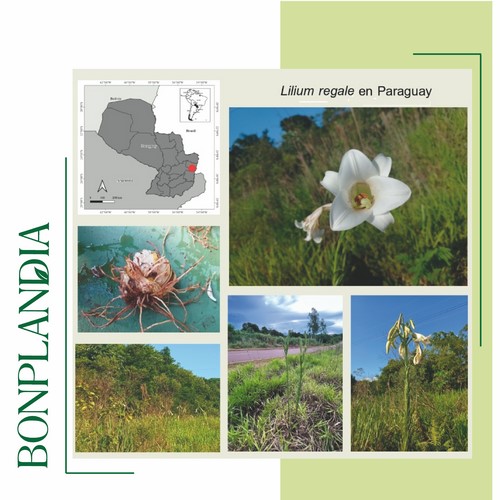
The genus Lilium (Liliaceae) and the species L. regale are reported for the first time in Paraguay. This exotic species, native to Asia, is widely distributed in temperate – cold regions of Asia and Europe and has become acclimatized in some South American countries. Specimens were collected in District of Mbaracayú, Alto Paraná Department, Paraguay, located in the Itaipu Biosphere Reserve. This work presents a brief description of the species, its phenology, dispersal, ecology, and distribution in the country. Lilium regale is considered a species in the process of naturalization in Paraguay.
Downloads
References
Dahlgren, R. M. T., Clifford, H. T., Yeo, P. F. (1985). The families of the monocotyledons: structure, evolution and taxonomy. Sringer, Berlin. https://doi. org/10.1016/s0031-9422(00)80731-1
Dehnen-Schmutz, K., Touza, J., Perrings, C. & Williamson, M. (2007). The horticultural trade and ornamental plant invasions in Britain. Conservation Biology 21: 224-231. https://doi.org/10.1111/j.1523- 1739.2006.00538.x
Dimitri, M. J. (1987). Liliáceas. Enciclopedia Argentina de Agricultura y Jardinería 1: 224-225. ACME, Buenos Aires.
Foxcroft, L. C., Richardson, D. M. & Wilson, J. (2008). Ornamental plants as invasive aliens: problems and solutions in Kruger National Park, South Africa. Environmental Management 41: 32-51. https://doi. org/10.1007/s00267-007-9027-9
Fragano, F. & Clay, R. (2005). Biodiversidad en el Bosque Atlántico del Alto Paraná de Paraguay. En Cartes, J. L. (ed.), El Bosque Atlántico en Paraguay: biodiversidad, amenazas, perspectivas, pp. 61-87. Asociación Guyra Paraguay.
Hurrel, J. A., Delucchi, G. & Tolaba, J. A. (2012). Flora del Valle de Lerma. Liliaceae. Aportes Botánicos de Salta, Serie Flora 11: 1-8.
Hurrell, J. A., Delucchi, G. & Keller, H. A. (2019). Lilium regale (Liliaceae) naturalizada en la Argentina y nuevos registros para Brasil austral. Bonplandia, 28: 71-75. https://doi.org/10.30972/bon.2813574
Liang, S. Y. & Tamura, M. (2000). Lilium L., Nomocharis Franchet. En Wu, Z. Y. & P. H. Raven (eds.), Flora of China, pp. 135-150. Science Press/Missouri Botanical Garden Press, Beijing/St. Louis.
Patterson, T. B. & Givnish, T. J. (2002). Phylogeny, concerted convergence, and phylogenetic niche conservatism in the core Liliales: Insights from rbcL and ndhF sequence data. Evolution 56: 233-252. https://doi.org/10.1111/j.0014-3820.2002.tb01334.x
Pyšek, P. & Richardson, D. M. (2006). The biogeography of naturalization in alien plants. Journal of Biogeography 12: 2040-2050. https://doi.org/10.1111/ j.1365-2699.2006.01578.x
REFLORA. (2025). Herbário Virtual. https://floradobrasil. jbrj.gov.br/reflora/herbarioVirtual/ (Consulta 03/2025).
Richardson, D. M., Pyšek, P., Rejmánek, R., Barbour, M., Panetta, F. D. & West, C. J. (2000). Naturalization and invasion of alien plants: concepts and definitions. Diversity and Distributions 6: 93-107. https://doi. org/10.1046/j.1472-4642.2000.00083.x
Schneider, A. A. (2007). A flora naturalizada no Estado do Rio Grande do Sul, Brasil: herbáceas subespontâneas. Biociências 15: 257-268.
Siljak-Yakovlev, S., Peccenini, S., Muratović, E., Zoldoš, V., Robin, O. & Vallès, J. (2003). Chromosomal differentiation and genome size in three European mountain Lilium species. Plant Systematics and Evolution 236: 165-173. https://doi. org/10.1007/s00606-002-0240-y
Skinner, M. W. (2002). Lilium. En Flora of North America Editorial Committee (ed.), Flora of North America, 26: Magnoliophyta: Liliidae: Liliales and Orchidales, pp. 172-197. Oxford University Press, New York.
Sousa Sobrinho, M., Machado Tabatinga, G., Machado, I. C. & Lopes, A. V. (2013). Reproductive phenological pattern of Calotropis procera (Apocynaceae), an invasive species in Brazil: annual in native areas; continuous in invaded areas of Caatinga. Acta Botanica Brasilica 27: 456-459. https://doi.org/10.1590/s0102-33062013000200018
TROPICOS. (2018). Tropicos.org, http://www.tropicos. org (consulta (03/2025). WFO. (2025). The World Online Flora, https://www. worldfloraonline.org/ (Consulta 03/2025).
Wilson, E. H. (1925). The lilies of eastern Asia: A monograph. Dulau and Company Limited, London.
Woodcock, H. B. D. & Stearn, W. T. (1950). Lilies of the world (2.ª ed.). Country Life Ltd., New York. https://doi.org/10.2307/4117214
Wu, Z. H., Shi, J., Xi, M. L., Jiang, F. X., Deng, M. W. & Dayanandan, S. (2015). Inter-simple sequence repeat data reveals high genetic diversity in wild populations of the narrowly distributed endemic Lilium regale in the Minjiang River Valley of China. Plos One 10: 1-17 https://doi.org/10.1371/journal. pone.0118831
Ying, K., Bai, J. R., Kong, X. D., Dou, X. Y. & Wang, N. Y. (2014). Floral scent composition of Lilium regale E. H. Wilson. Acta Horticulturae 1027: 81-86.
Zuloaga, F. O., Belgrano, M. J. & Zanotti, C. A. (2019). Actualización del Catálogo de las Plantas Vasculares del Cono Sur. Darwiniana, Nueva Serie 7: 208-278. https://doi.org/10.14522/ darwiniana.2019.72.86
Downloads
Published
Versions
- 2025-08-14 (2)
- 2025-08-01 (1)
How to Cite
Issue
Section
License
Copyright (c) 2025 Bonplandia

This work is licensed under a Creative Commons Attribution 4.0 International License.
Declaration of Adhesion to Open Access
- All contents of Bonplandia journal are available online, open to all and for free, before they are printed.
Copyright Notice
- Bonplandia magazine allows authors to retain their copyright without restrictions.
- The journal is under a Creative Commons Attribution 4.0 International license.










.jpg)