
Novelties of the genus Sematophyllum (Sematophyllaceae, Bryophyta) in Uruguay
DOI:
https://doi.org/10.30972/bon.3418380Keywords:
Bryophyta, Hypnales, Pampa, Rocha, Sematophyllum, taxonomyAbstract
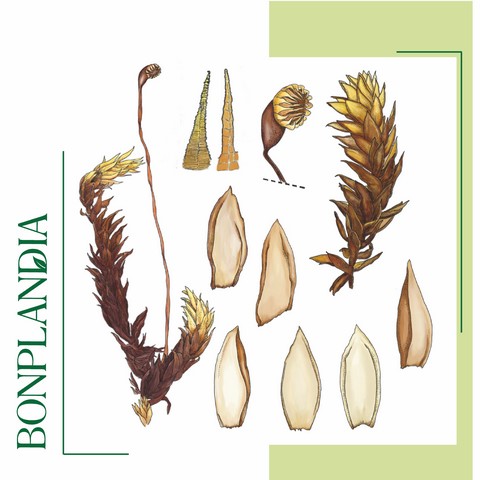
This study documents new records of the genus Sematophyllum in Uruguay. Four species, S. cuspidiferum, S. galipense, S. lithophilum, and S. subsimplex, are newly reported for the bryophyte flora of Uruguay, while the known distribution of S. subpinnatum is expanded. The study includes descriptions, illustrations, taxonomic notes, and additional observations for each species. An identification key is also provided.
Downloads
References
Allen, B. (2018). Moss Flora of Central America Part 4. Fabroniaceae-Polytrichaceae. Missouri Botanical Garden Press. USA.
Brotherus, V. F. (1893-1909). Musci. En A. Engler & K. Prantl. Die Natürlichen Pflanzenfamilien 1(3). Leipzig.
Buck, W. R. (1998). Pleurocarpous mosses of the West Indies. Memoirs of the New York Botanical Garden 82: 1-400.
Cabral, R. A., Jiménez, S. & Suárez, G. M. (2020). Calymperaceae, Una Nueva Familia Para La Flora briológica De Uruguay. Boletín de la Sociedad Argentina de Botánica 55: 359-67.
Carvalho-Silva, M., Stech, M.; Soares-Silva, L. H.; Buck, W. R., Wickett, N. J., Liu, Y. & Câmara, P. E. A. S. (2017). A molecular phylogeny of the Sematophyllaceae s.l. (Hypnales) based on plastid, mitochondrial and nuclear markers, and its taxonomic implication. Taxon 66: 811-831.
Costa, D. P. & Pôrto, K. C. (2023). Guia de Musgos do Brasil. Volume 2: Meteoriaceae—Thuidiaceae. New York Botanical Garden Press, Bronx, NY.
Churchill, S. P. & Linares, C. E. (1995). Prodromus Bryologiae Novo Granatensis Biblioteca José Gerónimo Triana 12: 1-924.
Churchill, S. P., Aldana, M. C., Opisso, J. & Morales, T. (2020). Familias y Géneros de los musgos de los Andes Tropicales. St. Louis: Missouri Botanical Garden, USA.
Crosby, M. R., Magill, R. E., Allen, B. & He, S. (1999). A Checklist of the Mosses. Missouri Botanical Garden, St. Louis.
Evangelista-dos-Santos, M. & de Brito Valente, E. (2023). The genus Brittonodoxa (Sematophyllaceae) in Brazil. Rodriguésia 74: 2-10.
Farías, R. M. & Matteri, C. M. (1999). Redescubrimiento de Sematophyllum grandicellulosum (C. Muell.) Broth. (Sematophyllaceae, Musci) y su distribución en el noroeste argentino. Revista del Museo Argentino de Ciencias Naturales 1: 7-11.
Felippone, F. (1929) [Effective date March 1930]. Contribution à la flore briologique de l’Uruguay. Revue Bryologique Nouevelle Série 2: 210-225. Fleischer, M. (1904-1923). Die Musci der Flora von Buitenzorg, (zugleich Laubmossflora von Java), vol. 4, en: Flore de Buitenzorg, Vème, Partie. Ed. Brill, Leiden, Países Bajos.
Frahm, J. P. (2003). Manual of tropical Bryology. Tropical Bryology 23: 1-200.
Gradstein, S. R., Churchill, S. P. & Salazar-Allen, N. (2001). Guide to the bryophytes of Tropical America. Memoirs of the New York Botanical Garden 86: 1-577.
Goffinet, B. & Buck, W. R. (2004). Systematics of the Bryophyta (mosses): From molecules to a revised classification. En Goffinet, B., Hollowell V. & R. Magill (eds.), Molecular systematics of bryophytes, pp. 205-239. Monographs in Systematic Botany from the Missouri Botanical Garden 98. Missouri Botanical Garden, USA.
Han, W. & Jia, Y. (2021). Phylogeny and classification of the Sematophyllaceae s.l. (Hypnales, Bryophyta). Journal of Systematics and Evolution 59: 524-540.
Hedenäs, L. & Buck, W. R. (1999). A phylogenetic analysis of the Sematophyllaceae. Lindbergia 24: 103-132.
Herter, W. G. (1933). Florula Uruguayensis, plantae avasculares. En Herter, W. G. (ed.), Ostenia, colección de trabajos botánicos dedicados a Don Cornelio Osten, en ocasión del LXX aniversario de su nacimiento. Estudios botánicos en la región Uruguaya Nº XIII. Montevideo, pp. 7-84. Uruguay. [Re-issued without change of pagination in separate covers, entitled “Florula Uruguayensis, plantae avasculares”. Estudios botánicos en la región Uruguaya Nº III, Montevideo, W. G. Herter].
Matteri, C. M. (2004). The mosses (Bryophyta) of Uruguay, their synonymy and distribution. Cryptogamie Bryologie 25: 147-167.
Morrone, J. J. (2002). Presentación sintética de un nuevo esquema biogeográfico de América Latina y el Caribe. Monografías Tercer Milenio 2: 267-275.
Oliveira-da-Silva, F. R. & Ilkiu-Borges, L. I. (2018). Flora of the canga of the Serra dos Carajás, Pará, Brazil: Sematophyllaceae. Rodriguésia 69: 1035- 1044.
Sharp, A. J., Crum, H. A. & Eckel, P. M. (eds.) (1994). The moss flora of Mexico. Memoirs of the New York Botanical Garden 69: 1-1113.
Suárez, G. M. & Schiavone, M. M. (2013). Contributions to the moss flora of Uruguay: the genus Pohlia (Bryophyta, Bryales), a new record. Darwiniana, nueva serie 1: 61-66.
Suárez, G. M., Schiavone, M. M. & Colotti, M. T. (2014). The genus Holomitrium (Dicranaceae, Bryophyta), new record in Argentina and Uruguay. Boletín de la Sociedad Argentina de Botánica 49: 457-461.
Suárez, G. M., Jimenez, M. S. & J. R. Flores, J. R. (2017). The genus Bartramia Hedw. (Bartramiaceae, Bryophyta) in Uruguay. Gayana Botánica 74: 123-127.
Suárez, G. M. & Mailhos, A. (2024). Contribuciones a la flora de musgos de Uruguay I: el género Trachyxiphium (Bryophyta, Pilotrichaceae) Lilloa 61: 129-134.
Downloads
Published
Versions
- 2025-08-14 (3)
- 2025-07-10 (2)
- 2025-07-01 (1)
How to Cite
Issue
Section
License
Copyright (c) 2025 Bonplandia

This work is licensed under a Creative Commons Attribution 4.0 International License.
Declaration of Adhesion to Open Access
- All contents of Bonplandia journal are available online, open to all and for free, before they are printed.
Copyright Notice
- Bonplandia magazine allows authors to retain their copyright without restrictions.
- The journal is under a Creative Commons Attribution 4.0 International license.










.jpg)