Urban growth stages of San Julian Port, Santa Cruz, Argentina
DOI:
https://doi.org/10.30972/geo.19375623Keywords:
Geographical location , population growth, urban expansion, southern patagoniaAbstract
Puerto San Julián is a small city with a relevant history for Patagonia, which emerged in the early twentieth century as a settlement related to the cattle exploitation of the region and for several decades its urban population was scarce. Towards the end of the 20th century, the crisis in livestock farming and the rise of the mining activity, since the 1990s, have generated a dynamic that is manifested in a process of urban and demographic growth linked to migratory movements. In this paper, based on the transformations of socioeconomic structures, we propose to analyze the geographic position and urban growth of Puerto San Julián, by means of a comparative approach of historical and current records, the aim is to determine what the socioeconomic structures were and to what
extent they influenced the geographic situation and urban growth. Methodologically, it carried out a compilation and bibliography analysis of scientific, technical, historical and geographical documents, also analysis of statistical information from the National Population Census. Likewise, plans and historical aerial photographs and satellite images from different dates were interpreted and
analyzed in order to generate thematic cartography, by means of a Geographic Information System.
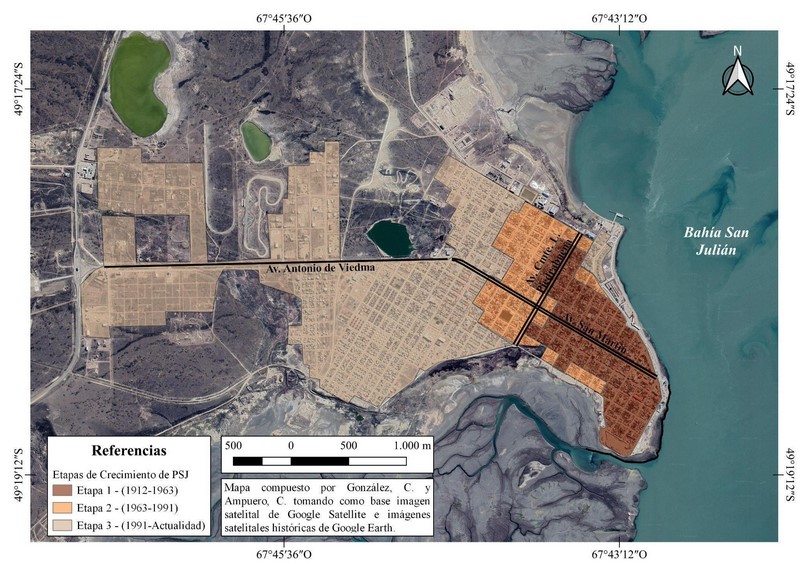
As a result, three stages of growth were identified, linked to economic and demographic dynamics. In conclusion, the socioeconomic dynamics of Puerto San Julián influenced the development of the city in the different stages.
Downloads
Published
How to Cite
Issue
Section
License
Copyright (c) 2022 Geográfica digital

This work is licensed under a Creative Commons Attribution-NonCommercial 4.0 International License.